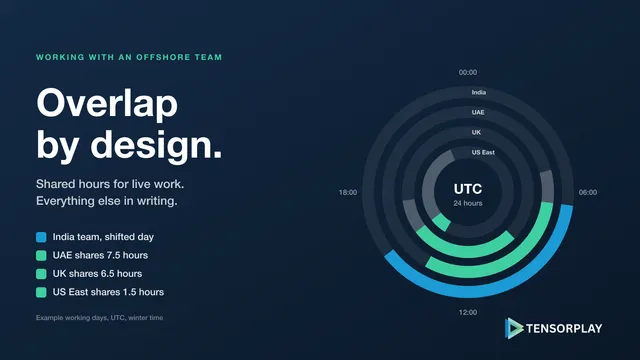
Working with an Offshore AI Team: Time Zones, IP and a Rhythm That Works
How to make an offshore AI or software team in India work from the US, UK, Europe or UAE: overlap hours, onboarding, security and IP, communication rhythm and what to measure.
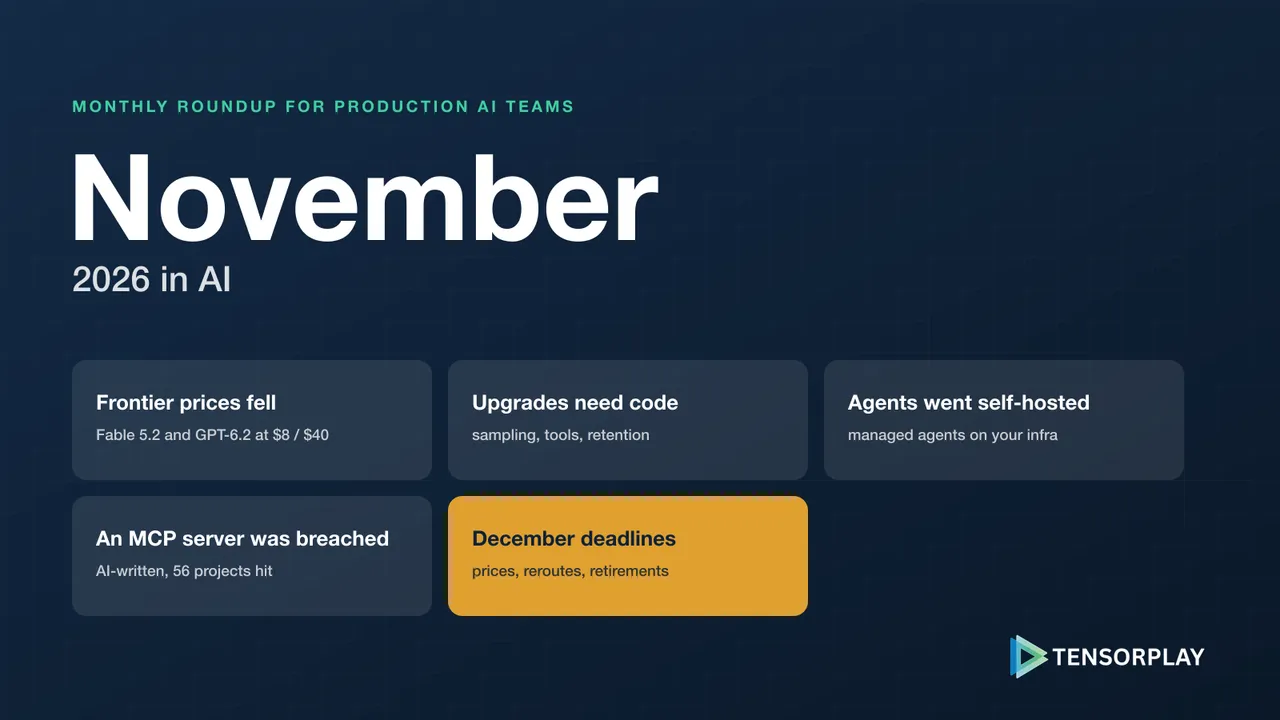
Three frontier labs cut or held prices, almost every upgrade now needs code changes, an MCP server became a breach path, and December opens with price rises, model reroutes and an EU AI Act date. Here is what to do before they land.
November gave production teams more capable models at lower prices, and a long list of things to change before the year ends. We covered two of the month’s launches in depth: Claude Fable 5.2 and Mythos 5.2 and Gemini 4 Neon and Hydrogen. This roundup covers everything else that matters for teams running AI in production.
Three of the big labs shipped new top models in November, and none of them raised prices.
Claude Fable 5.2 (9 November) costs $8 and $40 per million input and output tokens, down from $10 and $50 for Fable 5.1, with an optional fast mode at $16 and $80 that Anthropic says is up to 2.5 times faster (Anthropic). Anthropic reports 69.9% on FrontierSWE v2, against 56.3% for Fable 5.1 and 62.3% for Opus 5.5, and about 55% fewer safety-classifier blocks.
GPT-6.2 Astra and GPT-6.2 Sol (17 November) follow the same pattern (OpenAI). Astra costs $8 and $40, with cached input at $0.40, which OpenAI says is 20% cheaper on input and output than GPT-6 Astra and 60% cheaper on cached input. It has a 1,050,000-token context window, up to 922,000 tokens of input and 128,000 of output (OpenAI docs). Sol stays at $2 and $10.
Gemini 4 became a four-model family. Google made Carbon generally available on 10 November, released Hydrogen on 12 November at $1.50 and $7.50 with a free tier, and Neon on 18 November at $3 and $15 (Gemini API changelog, pricing).
Qwen4-Max (16 November) is Alibaba’s new hosted flagship: a mixture-of-experts model with 2.4 trillion total and 71 billion active parameters, a 1M-token context and native vision (Alibaba Cloud). Alibaba says it uses 35% fewer tokens than Qwen3.8-Max in High mode and costs about 60% less per task on its own Work360 benchmark. The flagship has no open weights; smaller open-weight Qwen4 models are promised “soon”.
Here is where the independent index stood at the end of the month:
| Rank | Model (effort) | Intelligence Index | Cost per index task |
|---|---|---|---|
| 1 | Claude Fable 5.2 (max) | 65 | $26.54 |
| 2 | GPT-6.2 Astra (max) | 62 | $4.00 |
| 3 | Gemini 4 Neon (xhigh) | 62 | $6.44 |
| 4 | Gemini 4 Carbon (high) | 60 | $7.76 |
| 5 | Claude Opus 5.5 (max) | 59 | $10.04 |
| 6 | GPT-6.2 Sol (max) | 57 | $1.01 |
Source: Artificial Analysis, Intelligence Index v5.0.2, read 28 November 2026. The methodology was updated on 24 November, which is why Neon now shows 62 rather than the 61 in our launch post.
What it means: the top six models are within eight points of each other, and cost per task varies by a factor of 26. GPT-6.2 Astra scores three points below Fable 5.2 at its maximum setting for about a seventh of the cost per task. For most workloads, the right question is no longer which model is best, but which model and effort level pass your evaluation at the lowest cost. Our inference cost guide and routing post cover how to answer it.
Swapping a model ID is no longer enough for any of the big three.
GPT-6.2 no longer accepts temperature, top_p or logprobs. Tool calling works only in the Responses API, top-level instructions are now placed after input, and Flex processing is not supported (OpenAI migration guide). OpenAI says new models will not support Flex at all. Its replacement is background completion windows in the Responses API: two-hour and eight-hour windows at 30% and 40% below standard rates, in public beta since 17 November (OpenAI changelog).
Claude Fable 5.2 enforces the thinking-block prefix check for every account, and computer_20251124 now returns a 400 error; use computer_toolset_20260801 instead (Anthropic release notes). Both Fable 5.2 and Mythos 5.2 require 30-day data retention and are not available under zero data retention unless Anthropic authorises it. That alone may rule them out for regulated workloads, so check your data agreements before you migrate.
Gemini 2.5 users face the biggest silent change. From 1 December, gemini-2.5-pro requests are routed to gemini-3.8-flash and gemini-2.5-flash requests to gemini-3.5-flash-lite, with breaking changes including thinking_level replacing thinking_budget and sampling parameters removed (Gemini API changelog). If you have not migrated, your production traffic will move to a different model on that date whether you test it or not.
defer_loading: true and the model loads their schemas only when it needs them, including tools on remote MCP servers. For agents with dozens of tools, that cuts prompt size and cost.deepseek-flash, across Anthropic- and OpenAI-style endpoints, plus standalone search, OCR, speech and text-to-speech APIs (DeepSeek). That makes it easier to use as a low-cost fallback.Two reports this month should change how teams treat their AI tools.
The Mittwald MCP breach. The German hosting company published a post-mortem on 25 November (Mittwald). An SSH-key tool in its own MCP server passed tool-call arguments into a shell command, which allowed command injection. Exploitation began on 27 October and was detected on 4 November. Several thousand OAuth tokens were taken, a few hundred of them still valid, along with configuration files, keys and database dumps, and 56 projects were confirmed compromised. Mittwald says the code was “largely written with AI coding agents” and the flaw was missed in review and static analysis. The server stays offline until it is rebuilt with a read-only filesystem, restricted outbound traffic and short-lived tokens.
It is the clearest example yet of the risk we described in Is Your Vibe-Coded App Ready for Real Users?: AI-written code that works, ships and is never checked for the one input that matters.
Google’s agentic threat report (17 November). Google Threat Intelligence describes the first fully automated exploitation it has seen in the wild: an exposed server running an agent that diffs patches, drafts exploits and runs them with no human involved (Google Cloud). The report also covers:
.claude/settings.json in repositories so that opening the project in Claude Code downloaded malware.OpenAI’s own launch announcement adds a different kind of warning: GPT-6.2 Astra is the first model OpenAI has released that meets its “High” threshold for AI self-improvement, and both GPT-6.2 models meet its “Critical” cybersecurity threshold (OpenAI).
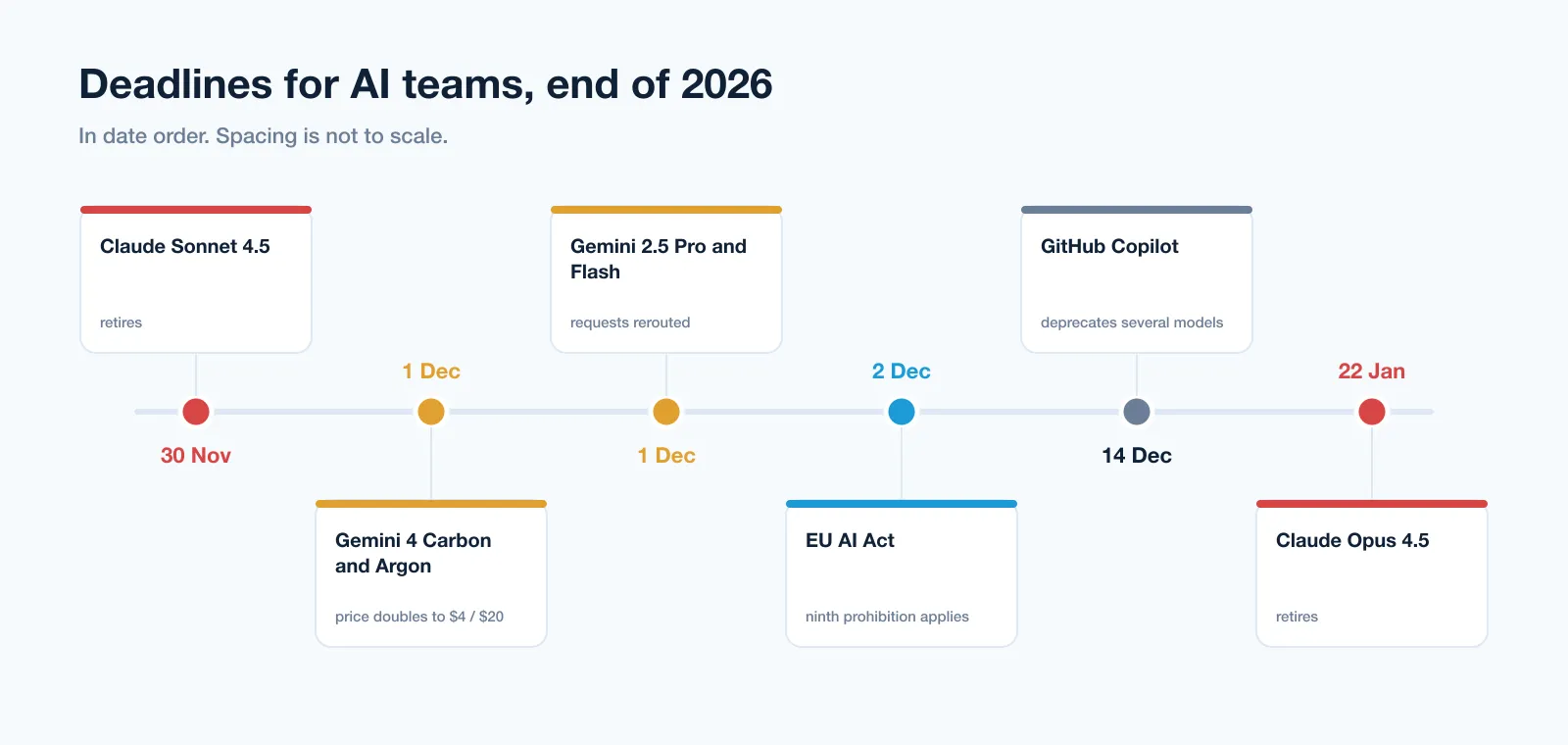
claude-sonnet-4-5-20250929, which retires that day (Anthropic). Anthropic recommends Sonnet 5.5.gemini-2.5-pro or gemini-2.5-flash calls yourself, and replace thinking_budget with thinking_level, rather than letting the reroute choose for you.temperature, top_p and logprobs, move tool calls to the Responses API, and move Flex jobs to background windows.computer_toolset_20260801..claude/settings.json like any other code.claude-opus-4-5-20251101.Seven. That is roughly how many times more Claude Fable 5.2 at maximum effort costs per index task than GPT-6.2 Astra at maximum effort, for a three-point higher score. Sometimes those three points are worth it. Often they aren’t, and the only way to know is to measure on your own tasks. Our LLM evaluation framework shows how.
If you want help turning December’s deadlines into a migration plan, or reviewing the MCP servers and agents you already run, talk to Tensorplay about an AI architecture review.
Answers to common questions about this topic.
How to make an offshore AI or software team in India work from the US, UK, Europe or UAE: overlap hours, onboarding, security and IP, communication rhythm and what to measure.
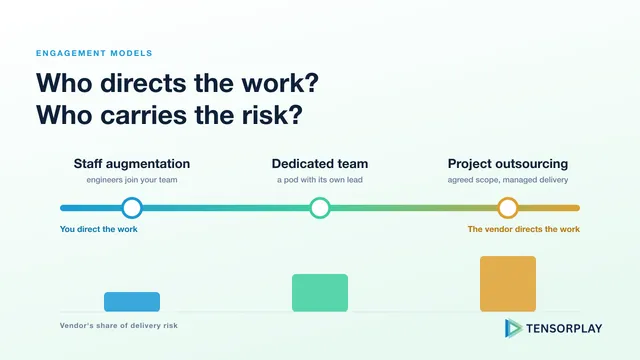
Staff augmentation, project outsourcing and dedicated teams compared for AI and software work: who directs the work, who carries delivery risk, how pricing works and when each fits.
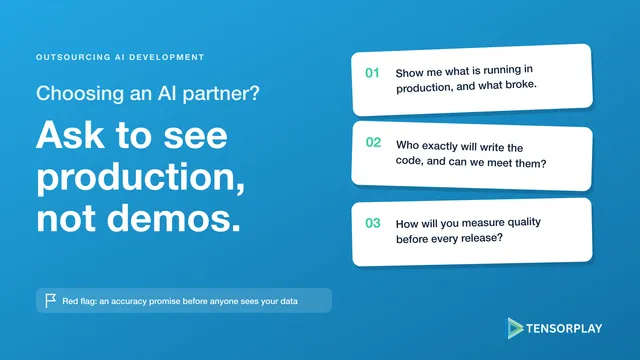
A practical guide to outsourcing AI development: the questions to ask a partner, the red flags to watch for, what to put in the contract, and how to run a paid trial.
For founders
Turn a raw idea into a working proof of concept or MVP in weeks, not months, so you can validate before you over-invest.
Book a discovery callFor AI builders
AI-native applications, curated datasets and trained models, built by engineers who run AI systems in production.
Discuss your AI projectFor scaling teams
Vetted tech specialists who plug directly into your sprint cycle, without the hiring overhead.
Request engineersFor tech leaders
Direct access to experienced engineering leaders for architecture reviews, engineering management and crisis unblocking.
Book a strategy session