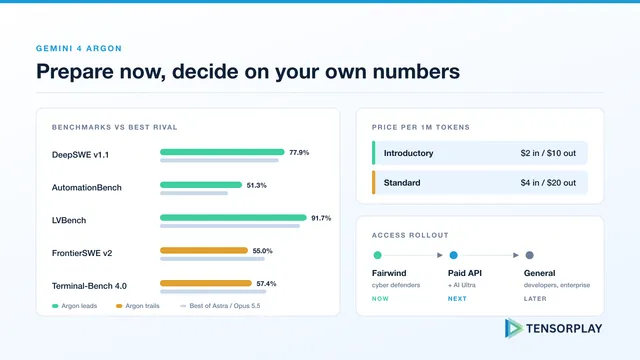
Gemini 4 Argon: Get Ready Before You Can Call It
Gemini 4 Argon for production AI teams: benchmarks against GPT-6 Astra and Opus 5.5, pricing that doubles after launch, 1M output tokens and a readiness plan.
Google shipped two Flash models in three weeks. Here is what that does to your model routing, your budget and your release process.
Google released Gemini 3.7 Flash on 13 August 2026 and Gemini 3.8 Flash on 2 September 2026, both generally available in the Gemini API (release notes). Google describes 3.8 Flash as its most intelligent Flash model, built for long-horizon software engineering, autonomous agents and complex enterprise workflows.
The Flash tier used to be the model you chose when a task was simple enough to tolerate a weaker model. These two releases move it into work that most teams route to a Pro or frontier model. That shifts the economics of a production AI system, and it also creates operational work that is easy to miss in the excitement.
The published numbers for 3.7 Flash against the previous 3.6 Flash are large for a point release (DataNorth summary):
| Benchmark | Gemini 3.6 Flash | Gemini 3.7 Flash |
|---|---|---|
| DeepSWE v1.1 | 49.0% | 65.3% |
| FrontierCode 1.1 Main | 34.4% | 43.6% |
| AutomationBench | 17.0% | 30.4% |
3.7 Flash ships a 1,048,576-token input window and a 65,536-token output limit, with a knowledge cutoff of March 2026. 3.8 Flash adds more iterative tool calling and extra reasoning steps on hard tasks, and Google reports 54.9% on HLE-Verified along with gains on financial and legal evaluations (9to5Google).
Benchmarks are not your workload. What they tell you is where to look: coding agents, multi-step automation and structured extraction over long documents are the tasks where a Flash model may now clear the acceptance bar that previously required a larger model. Confirm that with your own evaluation set before changing anything, using the approach in our LLM evaluation framework.
Both models are on an introductory price of $0.75 per million input tokens and $3.75 per million output tokens until 31 December 2026. For 3.7 Flash the standard price after that is $1.50 and $7.50. If your cost model uses the introductory rate, your January 2027 bill doubles with no change in traffic.
Treat the standard price as the real price in every routing decision and forecast now. A workflow that only makes economic sense at the introductory rate is a workflow you will be re-architecting during the holidays. Our guide to reducing LLM inference costs covers the instrumentation you need to see cost per workflow rather than a single monthly total.
Sampling parameters are deprecated. With the July 2026 release of Gemini 3.6 Flash, Google deprecated the temperature, top_p and top_k parameters. Any prompt tuned with a low temperature for deterministic extraction, or a high one for creative variety, needs to be re-evaluated on 3.7 or 3.8 Flash without those controls. Structured output schemas and explicit instructions have to carry the load instead. If your prompts live in a registry with versioned evaluations, as described in prompt engineering at scale, this is a contained change. If they are scattered through application code, it is a project.
Release cadence is now weeks. Three Flash models in seven weeks means a model alias that floats to the latest version will change behaviour under you several times a quarter. Pin explicit model versions in production, run your evaluation suite against each new release in a staging environment, and promote deliberately. A regression in output format or tool-call structure is far more common between versions than a regression in headline accuracy.
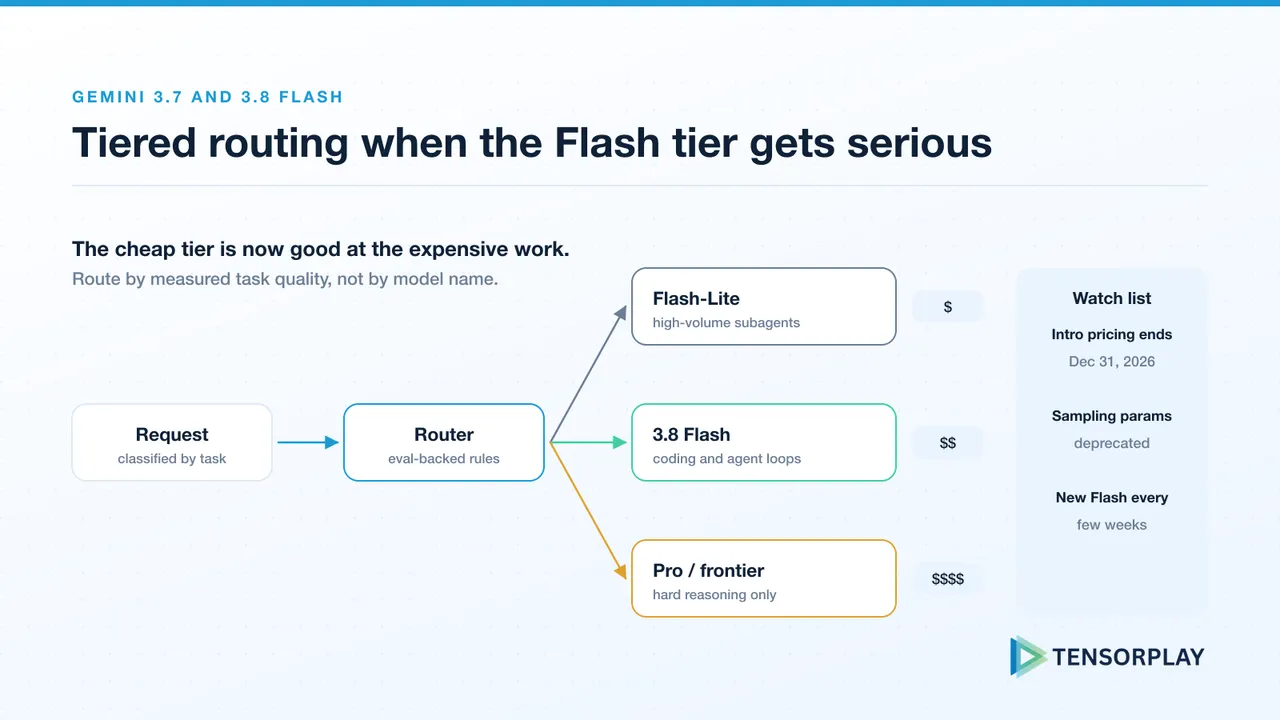
The useful architecture is three tiers, selected by measured task quality rather than by model name:
The router itself should be boring: rules derived from evaluation results, with a per-workflow override and a fallback to the next tier up on failure or refusal. The routing section of our LLM inference cost playbook walks through building that evaluation-backed router.
One more boundary to note: Gemini 3.8 Flash Cyber, the security-focused variant, is limited to trusted testers through Google’s Fairwind Program. It is not in the general API, so do not plan security tooling around it yet.
If you want help deciding where the new Flash models fit in your architecture, or building the evaluation-backed routing to use them safely, talk to Tensorplay about a model routing review.
Answers to common questions about this topic.
Gemini 4 Argon for production AI teams: benchmarks against GPT-6 Astra and Opus 5.5, pricing that doubles after launch, 1M output tokens and a readiness plan.
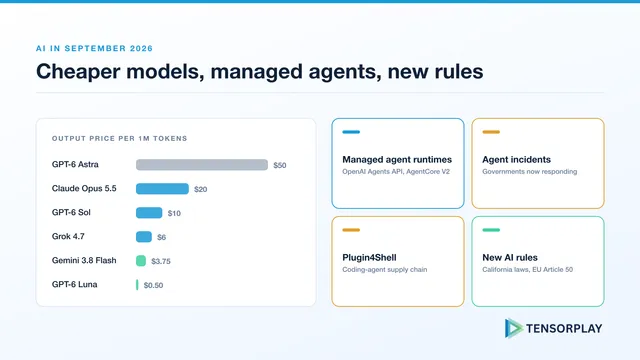
The AI news from September 2026 that matters to teams shipping AI: Claude Opus 5.5, GPT-6 Sol and Luna pricing, OpenAI's Agents API, Plugin4Shell, California's new AI laws and a migration checklist.
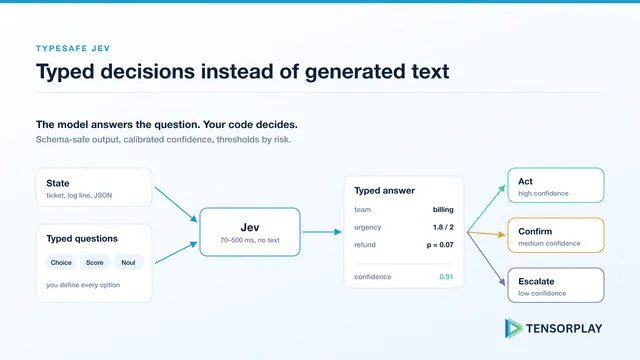
TypeSafe's Jev explained for production AI teams: typed Choice, Score and Noul answers, confidence gating, $0.042 per million input tokens, and the caveats in its benchmarks.
Improve model quality, control costs, and establish repeatable evaluation systems.
Discuss your projectBuild secure inference platforms with predictable performance and spend.
Discuss your project