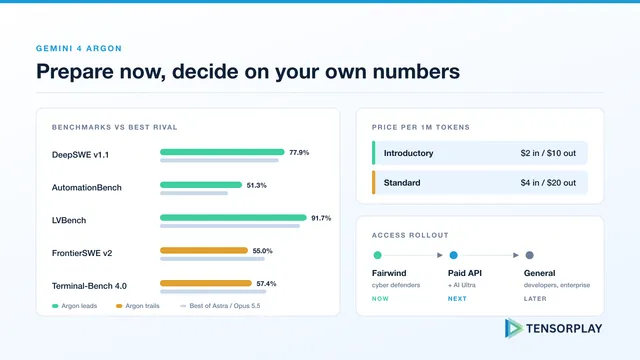
Gemini 4 Argon: Get Ready Before You Can Call It
Gemini 4 Argon for production AI teams: benchmarks against GPT-6 Astra and Opus 5.5, pricing that doubles after launch, 1M output tokens and a readiness plan.
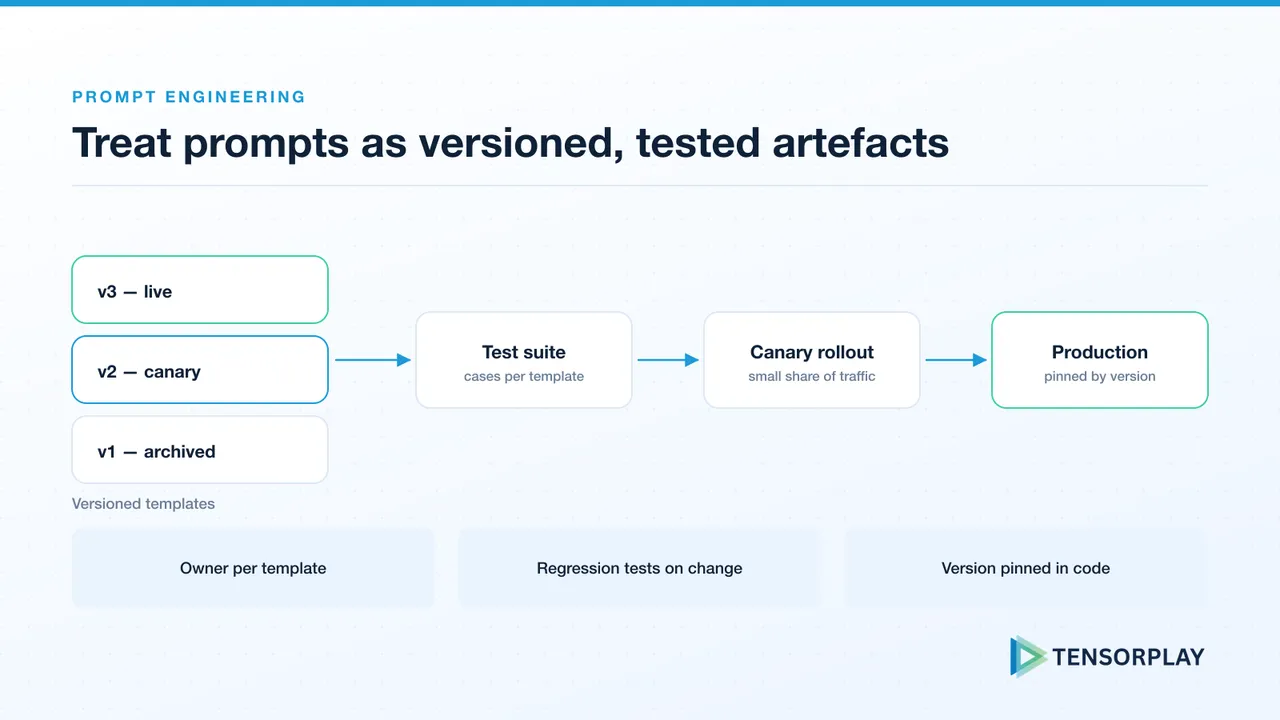
When you have hundreds of prompt templates in production, ad-hoc prompt engineering breaks down fast.
Prompt engineering has a reputation problem. For many developers, it conjures images of trial-and-error, magical incantations, and vague advice like “be more specific.” At small scale — one or two prompts — that approach is fine. At production scale — dozens of prompt templates, multiple models, and continuous iteration — it’s a disaster.
Here’s how we think about prompt engineering as a proper engineering discipline.
This is the foundational rule. Prompts belong in version control (not hardcoded in application files), they have tests, they go through code review, and changes to them have a deployment process.
We typically store prompts as YAML files that include:
Every prompt change should run against your evaluation suite before it can be merged. This means having:
Without this, you’re shipping prompt changes blind and wondering why your users are suddenly getting worse responses two weeks after a “small” update. Our LLM evaluation framework covers how to build the test set and set release thresholds.
For prompt changes that pass offline evaluation but you’re not fully confident about, run a production A/B test. Route 10% of traffic to the new prompt and compare real user quality signals — engagement, thumbs up/down feedback, follow-up questions (a sign of incomplete answers), and support escalations.
Build this infrastructure once and it pays off every time you iterate on any prompt.
When your prompt needs to return structured information, always specify a JSON schema and use your LLM provider’s structured output features (OpenAI’s response_format, Instructor, Outlines, etc.). Never parse free-form text when you don’t have to.
Structured outputs eliminate a whole class of failures and make your system dramatically more robust — you always know exactly what shape the data will be. Validate them at the API boundary too; our guide to designing AI-powered APIs shows how.
Many applications mix all prompt content into one blob. Instead, maintain clear separation:
This separation makes each piece easier to iterate on independently and easier to debug when something goes wrong.
Prompt engineering done right is software engineering, and versioned, tested prompts are one of the items on our AI production readiness checklist. If your team is struggling to maintain quality across a growing library of prompts, talk to Tensorplay about your prompt infrastructure.
Answers to common questions about this topic.
Gemini 4 Argon for production AI teams: benchmarks against GPT-6 Astra and Opus 5.5, pricing that doubles after launch, 1M output tokens and a readiness plan.
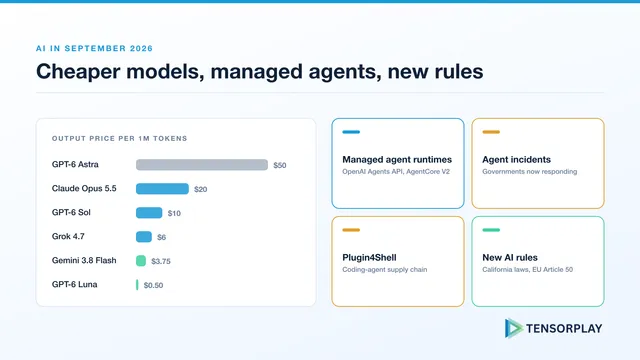
The AI news from September 2026 that matters to teams shipping AI: Claude Opus 5.5, GPT-6 Sol and Luna pricing, OpenAI's Agents API, Plugin4Shell, California's new AI laws and a migration checklist.
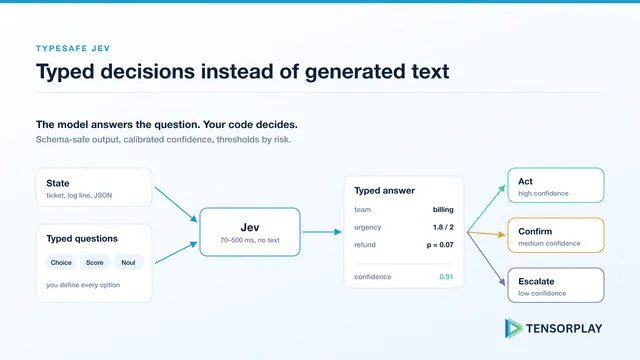
TypeSafe's Jev explained for production AI teams: typed Choice, Score and Noul answers, confidence gating, $0.042 per million input tokens, and the caveats in its benchmarks.
Turn prototypes into reliable, observable, and scalable AI systems.
Discuss your projectImprove model quality, control costs, and establish repeatable evaluation systems.
Discuss your project