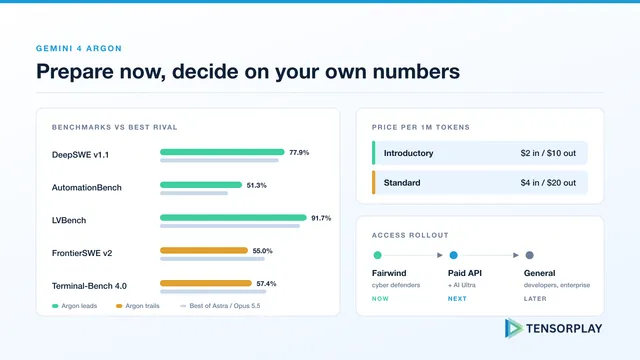
Gemini 4 Argon: Get Ready Before You Can Call It
Gemini 4 Argon for production AI teams: benchmarks against GPT-6 Astra and Opus 5.5, pricing that doubles after launch, 1M output tokens and a readiness plan.
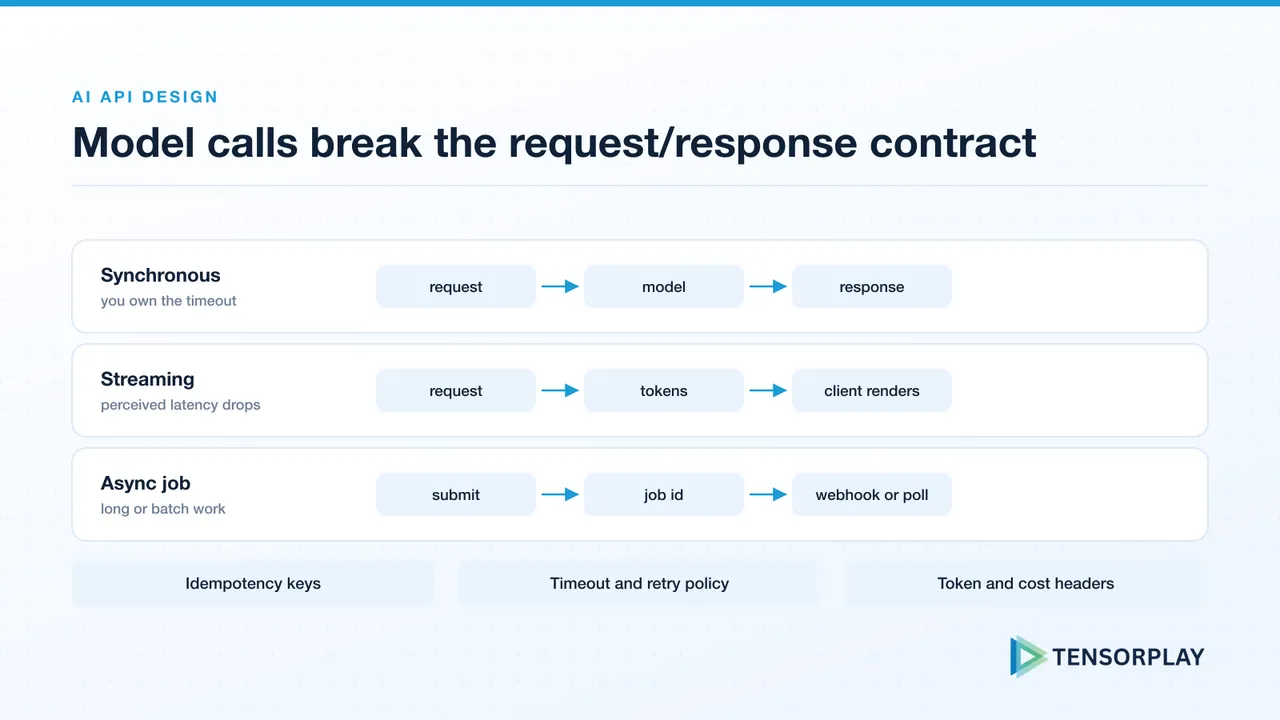
AI APIs have fundamentally different characteristics from traditional APIs — and they need different design patterns.
Building an API that wraps an AI model sounds straightforward — take input, call model, return output. In practice, the stochastic, latency-variable, and potentially expensive nature of LLMs demands patterns you’d never use in a traditional CRUD API.
Here are the core patterns we apply to every AI API we build.
Every AI API request should immediately return a request ID, even if the actual work is async. This is your debugging lifeline. When a user says “this response was wrong,” you look up the request ID and replay the exact inputs, prompt, and model state that produced it.
Store the full request context — inputs, prompt template version, model parameters, raw model output — for every call. The storage cost is trivial; the debugging value is enormous. It is also the foundation of the observability requirements in our AI production readiness checklist.
For any LLM response that might take more than 2 seconds to generate, implement streaming. Users experience streamed responses as dramatically faster and more responsive, even when total generation time is identical. A blank loading state for 8 seconds feels like failure; watching tokens appear within 200ms feels like it’s working.
Use Server-Sent Events (SSE) for HTTP streaming. Implement proper SSE connection handling on both client and server, including reconnection logic.
Your model will eventually return something unexpected. Design your output parsing to degrade gracefully rather than throwing errors. Always validate the structure of model outputs before passing them downstream, and have sensible fallback behavior when validation fails.
Use Pydantic models or JSON Schema validation at every model output boundary. Log validation failures as structured events so you can monitor the rate of output format failures over time. Schemas work best when the prompt asks for them explicitly; see prompt engineering at scale for managing that across many templates.
Standard rate limiting (requests per minute) is insufficient for AI APIs because request cost varies enormously. A 10-token request and a 4,000-token request consume the same rate limit slot but have wildly different costs.
Implement token-based rate limiting wherever possible. Track token consumption per-user and per-organization and enforce limits at that granularity. The same per-user token data tells you where to start when you need to reduce LLM inference costs.
If a streaming response disconnects halfway through, what happens? If a user retries a failed request, will they be charged twice? AI API idempotency is harder than traditional APIs because model outputs are stochastic.
For critical operations, implement idempotency keys and cache the model output for a short window. For idempotency keys that arrive within the cache window, return the same cached response.
Well-designed AI APIs are a competitive advantage — they’re faster, cheaper to operate, and more reliable than naive implementations. If you’re designing an AI API from scratch, talk to Tensorplay about an architecture review.
Answers to common questions about this topic.
Gemini 4 Argon for production AI teams: benchmarks against GPT-6 Astra and Opus 5.5, pricing that doubles after launch, 1M output tokens and a readiness plan.

Tensorplay launches Rêver Studio, an online client gallery for photographers in India with 40+ themes, AI face grouping and AI culling that flags duplicates, blur and closed eyes. Start free with 5 GB.
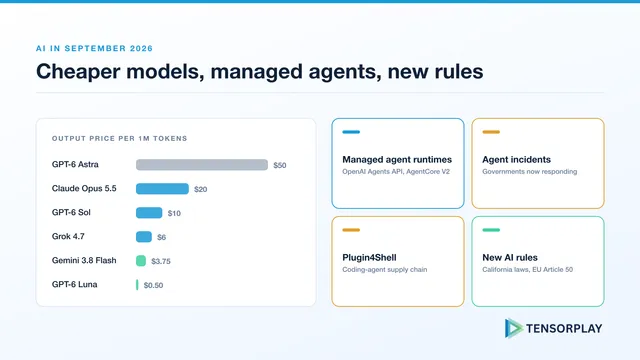
The AI news from September 2026 that matters to teams shipping AI: Claude Opus 5.5, GPT-6 Sol and Luna pricing, OpenAI's Agents API, Plugin4Shell, California's new AI laws and a migration checklist.
Turn prototypes into reliable, observable, and scalable AI systems.
Discuss your project