Gemini 4 Argon: Get Ready Before You Can Call It
Google's new frontier model leads most of its launch benchmarks, but there is no public model ID yet. Use the gap to prepare.
- Tensorplay Engineering
- 04 Oct, 2026
- 5 min read
- Llm,Production-ai
A frontier model you cannot call yet
Google announced Gemini 4 Argon on 30 September 2026 as the first model of its fourth Gemini generation (Google). It is aimed at long-horizon reasoning, coding, enterprise automation and defensive security, and on Google’s published results it leads most of the current frontier benchmarks.
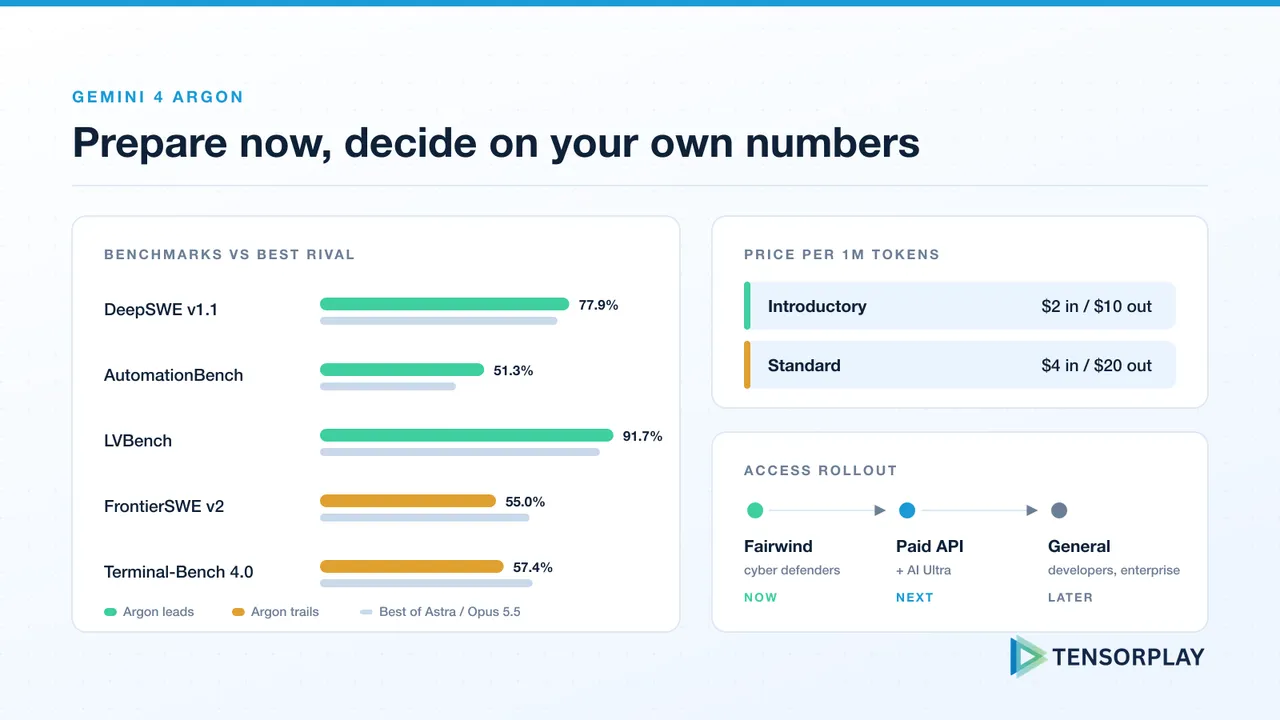
You cannot use it in production yet. Argon is rolling out first to trusted cyber defenders through Google’s Fairwind Program. Paid API customers and Google AI Ultra subscribers come next, then broader developer, enterprise and consumer access. Google has not given a date, and as of this week there is no public API model ID, model card or rate limit documentation (DataCamp).
That gap is useful. Teams that spend the next few weeks preparing will be able to make a decision on Argon within days of access opening, rather than weeks.
Short on time? Watch the one-minute summary.
Where Argon leads, and where it does not
Google published 18 benchmark results, and Argon leads or ties in 13 of them (VentureBeat). The comparison against the two models most teams are weighing it against:
| Benchmark | Gemini 4 Argon | GPT-6 Astra | Claude Opus 5.5 |
|---|---|---|---|
| DeepSWE v1.1 (software eng.) | 77.9% | 74.1% | 74.2% |
| AutomationBench (business tasks) | 51.3% | 41.4% | 42.5% |
| LVBench (long video) | 91.7% | 87.5% | 83.7% |
| GraphWalks BFS, 256K to 1M ctx | 84.2% | 71.8% | 66.8% |
| Harvey Legal Agent | 19.6% | 5.4% | 3.8% |
| FrontierSWE v2 | 55.0% | 65.5% | n/a |
| Terminal-Bench 4.0 | 57.4% | n/a | 66.4% |
Argon is also tied for first on CWE-bench v1 for vulnerability remediation at 68%, and Google reports leading results on the Gray Swan indirect prompt injection benchmark.
Two patterns are worth noting. The largest margins are on long-context and enterprise workflow tasks: reasoning over hundreds of thousands of tokens, multi-step business automation and legal agent work. The losses are on agentic terminal work and the hardest software engineering tasks, which are exactly what many teams use coding agents for. A model that wins the headline table can still lose on your workload, which is why the evaluation set you already own matters more than any of these numbers.
The price is lower than Astra, and it will double
Argon launches at an introductory $2 per million input tokens and $10 per million output tokens. Cached input gets a 95% discount, which is $0.10 per million at the introductory rate. The standard price after the introductory period is $4 and $20, and Google has not said when that switch happens.
Even at the standard price, Argon is well below GPT-6 Astra’s launch API price of $10 and $50 (our Astra analysis). That makes it a realistic candidate for workloads where Astra was too expensive to justify.
The same warning we gave for Gemini 3.8 Flash applies here. Build every forecast on the standard price. A workflow that only pays for itself at $2 and $10 will need redesigning on short notice, because the end date is not published.
Caching changes the numbers a great deal. An agent that resends a large, stable system prompt and tool definitions on every turn pays a fraction of the input cost if those tokens are cached. If your prompts are assembled with variable content at the top, restructure them now so the stable prefix comes first. The LLM inference cost guide covers how to measure the effect per workflow.
One million output tokens is a capability and a liability
Argon raises the output limit from 64,000 tokens to 1 million. Google’s own examples show why: internal teams used it to scale C and C++ to Rust migrations to more than 800,000 lines on the Fuchsia Zircon kernel, and to replace 32,000 lines of SIMD code in the libgav1 video decoder, producing a port 2.7 times faster than the previous Rust version.
For most production systems, the new limit is a risk to manage before it is a feature to use:
- Cost per call. One maximum-length response costs $10 at the introductory price and $20 at the standard price. Set an explicit output cap per workflow rather than relying on the model default.
- Timeouts. Generating hundreds of thousands of tokens takes minutes. Request timeouts, load balancer limits and serverless execution caps that were sized for 64K responses will cut these calls off. Stream the response and design for resumption.
- Validation. A 500,000-token code change cannot be reviewed the way a 500-line one can. Large generations need automated checks such as compilation, tests and diff-level policy checks before any human review.
Security work is the first use case
Google trained Argon for defensive security and says it can autonomously find, validate and patch critical vulnerabilities. Fairwind members get a version without the cyber guardrails that will apply to general access. Wiz used it through its Scan for Good initiative to find a critical healthcare software vulnerability that earlier frontier models had missed.
Expect the general release to refuse some security requests, as GPT-6 Astra does. If you are planning to use Argon for security tooling, test the refusal rate on your own prompts once access opens, and do not assume general API behaviour will match the Fairwind results.
The other side is also relevant. A model that is better at finding vulnerabilities is better at finding them for anyone who gets similar capability. Treat the threat model for your AI applications as a living document, and shorten your patch window for internet-facing services.
What to do before access opens
- Make your provider layer model-agnostic. Argon has no published model ID, and Google’s release cadence is now weeks. Model names should be configuration, not code.
- Prepare an evaluation run. Pick the three or four workflows where you would most like a better model, freeze their evaluation sets, and record current quality, latency and cost per successful outcome so the comparison is ready on day one.
- Re-forecast at $4 and $20. Compare that against what you pay today for the same workflows, including cache effects.
- Audit output limits and timeouts. Find every place that assumes a response fits in 64K tokens, from max token settings to gateway timeouts and storage fields.
- Check prompt structure for caching. Move stable content to the start of the prompt.
- Decide the gate in advance. Agree what Argon has to beat, and by how much, before you see the results, so the decision is not driven by launch excitement.
Argon may well be the best model for some of your workloads. The teams that benefit first will be the ones that can prove that with their own numbers within a week of getting access. If you want help building that evaluation and routing layer, talk to Tensorplay about a model readiness review.
Frequently asked questions
Answers to common questions about this topic.
Can I use Gemini 4 Argon through the Gemini API today?
How much does Gemini 4 Argon cost?
Is Gemini 4 Argon better than GPT-6 Astra and Claude Opus 5.5?
What does the 1 million output token limit mean in practice?
Related articles

Introducing Rêver Studio: AI Client Galleries and Culling for Photographers
Tensorplay launches Rêver Studio, an online client gallery for photographers in India with 40+ themes, AI face grouping and AI culling that flags duplicates, blur and closed eyes. Start free with 5 GB.
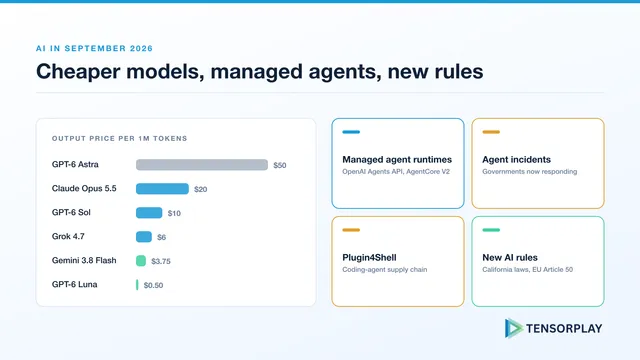
AI in September 2026: Cheaper Models, Managed Agents and New Rules
The AI news from September 2026 that matters to teams shipping AI: Claude Opus 5.5, GPT-6 Sol and Luna pricing, OpenAI's Agents API, Plugin4Shell, California's new AI laws and a migration checklist.
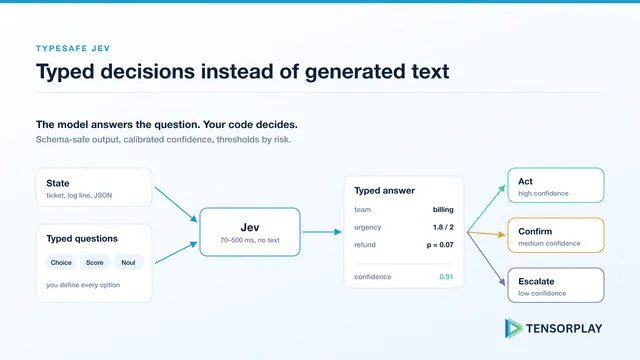
TypeSafe Jev: A Model That Makes Decisions Instead of Writing Text
TypeSafe's Jev explained for production AI teams: typed Choice, Score and Noul answers, confidence gating, $0.042 per million input tokens, and the caveats in its benchmarks.
How Tensorplay can help
Production AI Architecture
Turn prototypes into reliable, observable, and scalable AI systems.
Discuss your projectModel Optimization & Evaluation
Improve model quality, control costs, and establish repeatable evaluation systems.
Discuss your project