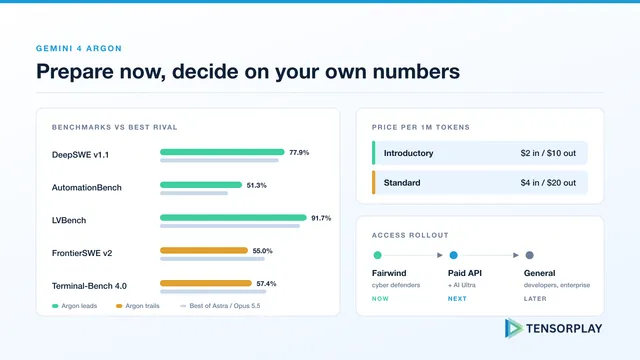
Gemini 4 Argon: Get Ready Before You Can Call It
Gemini 4 Argon for production AI teams: benchmarks against GPT-6 Astra and Opus 5.5, pricing that doubles after launch, 1M output tokens and a readiness plan.
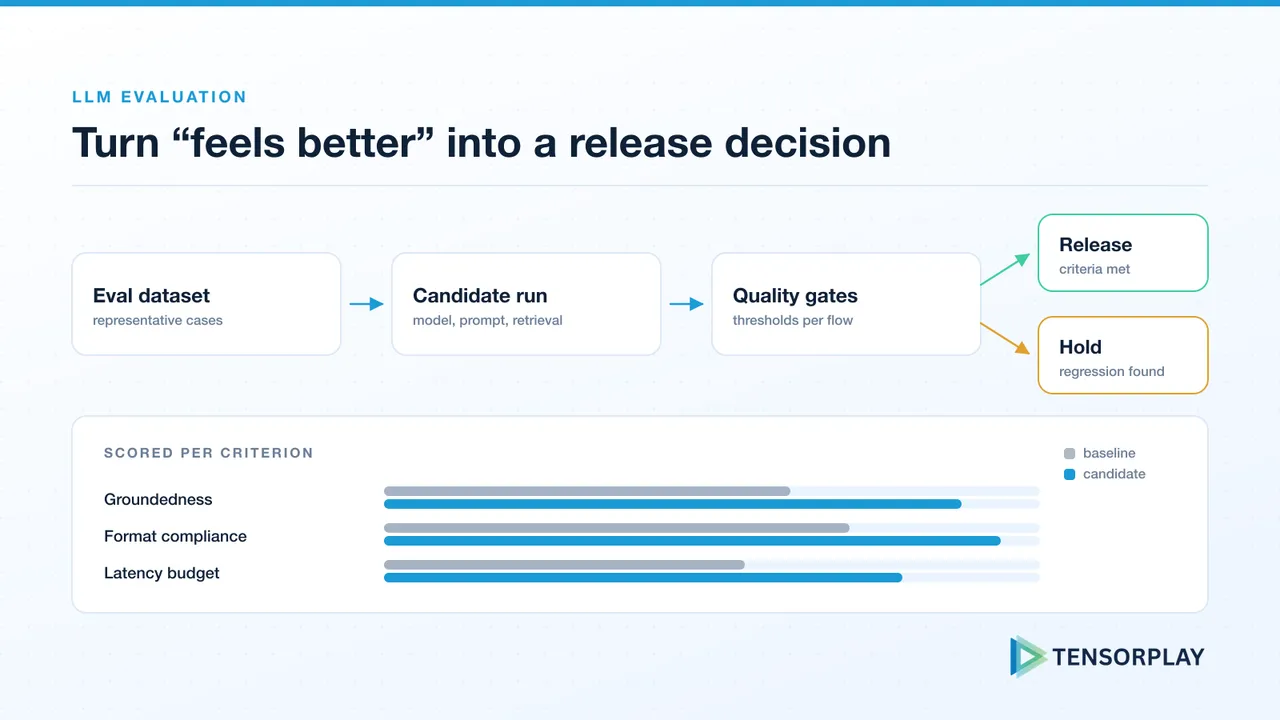
Benchmarks on static datasets don't tell you how your system performs for real users. A release decision built on your own data does.
Evaluating LLMs is one of the least glamorous parts of AI engineering and one of the most important. Without a rigorous evaluation system you cannot tell whether a prompt change made things better or worse, or whether a new model version is an upgrade or a regression. The system drifts, and nobody notices until customers do.
An LLM evaluation framework turns “does this feel better?” into a repeatable release decision. It combines a representative dataset, explicit quality criteria, automated checks, and a process for reviewing the cases automation cannot judge reliably. It sits inside the wider production-readiness work in our AI production readiness checklist: without it, model upgrades and prompt edits become unmeasured product changes.
This guide covers both halves of the problem: the decisions a CTO needs to make about what quality means and who owns it, and the engineering mechanics that make those decisions enforceable.
Public benchmarks tell you what a model can do on someone else’s data. They say little about your users, your documents or your output format. Start instead with the decisions your system helps users make, then describe what a good and a bad result looks like in that context. A support assistant may need grounded answers with correct citations; an extraction workflow may need a strict schema and high field accuracy; an internal coding assistant may need changes that compile and pass tests.
For each flow, define:
Writing this down per flow matters more than any tooling choice. It gives engineering, product and the business owner a shared definition of “good enough to ship”.
Your evaluation is only as good as its inputs. The most common mistake is generating synthetic test data with the same model you are testing: the model grades its own blind spots as correct, and the evaluation becomes circular. Build the dataset from:
As a working rule, aim for at least 200 to 500 examples before you trust aggregate numbers for a flow. Treat that as a floor for confidence rather than a target: coverage of the flows and failure types that matter is worth more than the raw count, and a small, well-labelled set beats a large noisy one.
Version the dataset alongside the code and refresh it at least quarterly. Production traffic shifts as users find new ways to use the product, and a test set frozen at launch slowly stops describing reality.
Offline evaluation runs before any change reaches production: a new model, a prompt edit, a retrieval change, a new tool or a policy update. It runs in CI against the golden dataset, and any change that degrades the score beyond your agreed threshold blocks the deployment.
Pick metrics that fit the task:
Offline tests cannot anticipate everything real users do, so keep monitoring production traffic. You cannot review every response, but you can sample. Combine automated signals (format failures, latency spikes, refusals, error rates) with periodic human review of a privacy-safe sample.
Track these over time for each workflow: a response quality score, refusal rate, formatting error rate, and semantic drift from a baseline. User signals such as corrections, thumbs-down ratings, escalations to a human and abandoned sessions are noisy individually but useful in aggregate.
For nuanced Q&A, tone-of-voice consistency or creative generation, string-matching metrics fall short. The LLM-as-judge pattern uses a separate, capable model to score outputs against a rubric you define. It scales far better than human review, but only if you treat the judge as a component that also needs testing.
The rules we apply:
An LLM result depends on more than the model. Many regressions blamed on “the model got worse” are really retrieval returning the wrong passages, a tool changing its response schema, or a parser silently dropping fields. Evaluate each boundary separately as well as end to end:
For systems built with LangChain and LangGraph, include state transitions and tool failures in the test set, not only final text. For agents, record what the agent touched as well as what it answered.
Capture the exact model version and inference configuration in every run, whether you use OpenAI or an open-source model from Hugging Face. Without that, a provider update or a change to your serving stack makes historical scores impossible to compare.
Not every flow deserves the same gate. High-risk flows, such as anything that gives advice, touches money or exposes customer data, should block a release when quality regresses. Lower-risk flows may be better served by sampled review or a feature-flagged rollout to a small audience. The point is not a perfect score; it is making trade-offs visible before customers encounter them.
Prompt changes deserve the same treatment as model changes. A “small” prompt edit that ships without evaluation is how responses quietly degrade two weeks later. If your prompts live in a versioned registry with tests, as described in prompt engineering at scale, wiring them into the same gate is straightforward.
The most valuable test cases come from production failures. Review a privacy-safe sample of bad outcomes regularly, work out why each one happened, and add it to the golden dataset so the same failure cannot ship again. Over time, every production failure becomes a permanent offline test case.
This loop has a second benefit: it reveals when a retrieval, data or product-design problem is being mistaken for a model problem. Teams without it tend to respond to every quality complaint by swapping models, which is expensive and rarely fixes the underlying cause.
Treat the evaluation suite as part of the product, not a one-off project:
That operating layer is part of a broader MLOps foundation for AI products. Without it, your AI system will silently degrade over time and your team will hear about it from customers first.
If your team needs help defining release criteria or building the evaluation pipeline, discuss your evaluation programme with Tensorplay.
Answers to common questions about this topic.
Gemini 4 Argon for production AI teams: benchmarks against GPT-6 Astra and Opus 5.5, pricing that doubles after launch, 1M output tokens and a readiness plan.
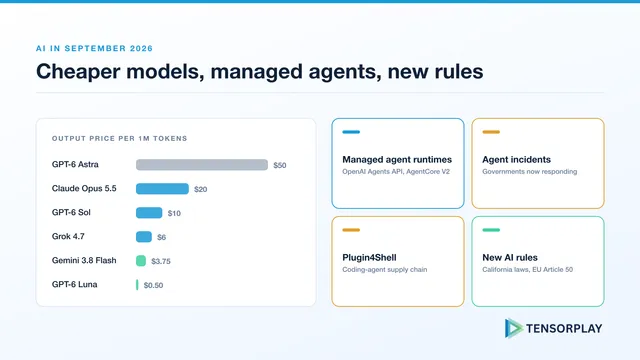
The AI news from September 2026 that matters to teams shipping AI: Claude Opus 5.5, GPT-6 Sol and Luna pricing, OpenAI's Agents API, Plugin4Shell, California's new AI laws and a migration checklist.
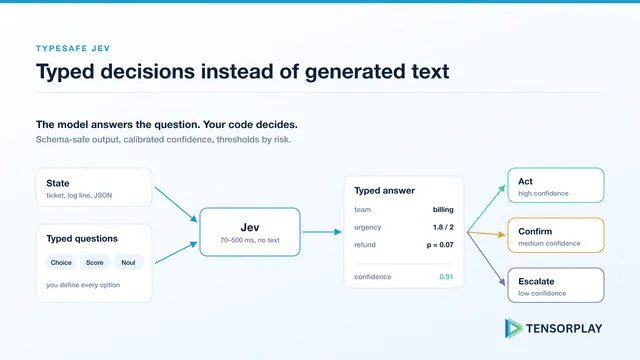
TypeSafe's Jev explained for production AI teams: typed Choice, Score and Noul answers, confidence gating, $0.042 per million input tokens, and the caveats in its benchmarks.
Improve model quality, control costs, and establish repeatable evaluation systems.
Discuss your project