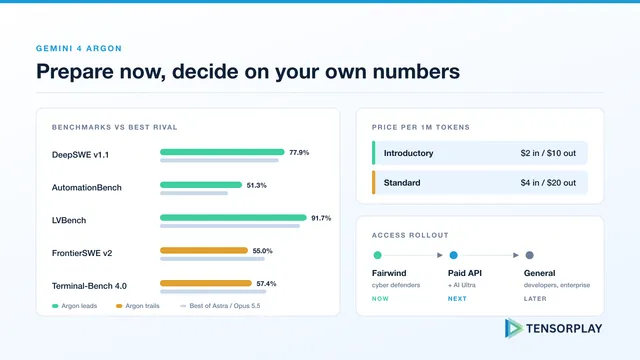
Gemini 4 Argon: Get Ready Before You Can Call It
Gemini 4 Argon for production AI teams: benchmarks against GPT-6 Astra and Opus 5.5, pricing that doubles after launch, 1M output tokens and a readiness plan.
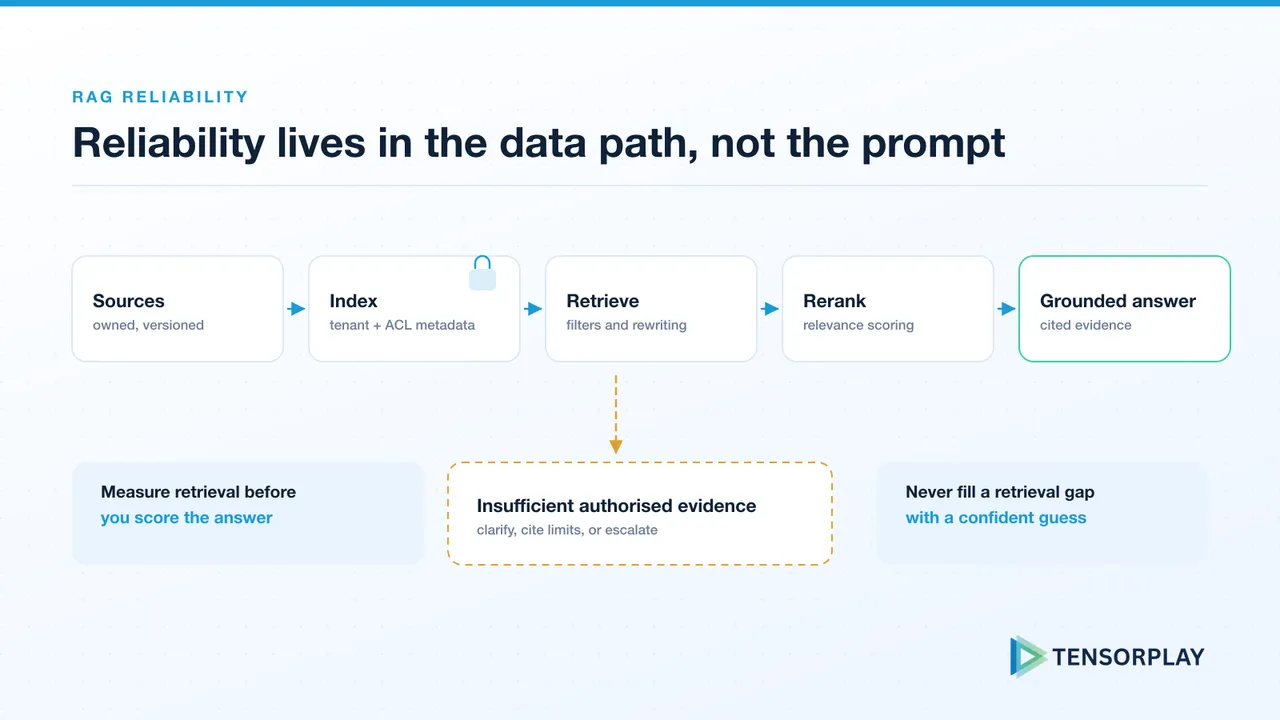
Reliability in retrieval-augmented generation comes from data, retrieval, permissions, and evaluation, not from a prompt alone.
A reliable RAG system retrieves authorized, current, relevant evidence and makes the model use that evidence predictably. The model is only one part of the system. Poor source data or retrieval quality cannot be repaired consistently with a longer prompt.
For the surrounding engineering work, review Tensorplay’s AI engineering services. The checklist below focuses on the decisions that prevent a promising RAG demo from becoming an unreliable production dependency.
Assign ownership for each source, define how updates are detected, and retain enough metadata to trace every chunk back to its origin. A retrieval result should carry document identity, timestamps, tenant or access attributes, and a clear lifecycle for deletion.
This is critical for systems using Pinecone: namespace design and metadata filters should enforce data boundaries before results reach the model. A vector index is not an authorization system by itself.
Test whether the relevant source appears in the retrieved results before scoring the final answer. If retrieval fails, investigate chunking, query rewriting, filters, embeddings, and ranking. If retrieval succeeds but the answer fails, investigate prompt construction and output validation.
This separation prevents teams from changing models when the actual fault is in the data path. It also gives the evaluation program a more actionable signal; see our LLM evaluation framework for CTOs.
Set a policy for weak evidence. The right behavior may be to show sources, ask a clarifying question, route to a human, or state that the system cannot verify an answer. Do not let the system fill a retrieval gap with a confident guess.
For complex workflows, LangChain and LangGraph can orchestrate retrieval and tool use, but the boundaries still need explicit validation and timeout behavior.
Monitor index update failures, retrieval latency, empty-result rates, filter denials, and query volume. On AWS, this may involve coordinated storage, event processing, and observability choices; our AWS AI infrastructure work covers those production concerns.
For the model-vs-retrieval decision, read RAG versus fine-tuning. If you need to assess a production RAG system, book a consultation with Tensorplay.
Answers to common questions about this topic.
Gemini 4 Argon for production AI teams: benchmarks against GPT-6 Astra and Opus 5.5, pricing that doubles after launch, 1M output tokens and a readiness plan.
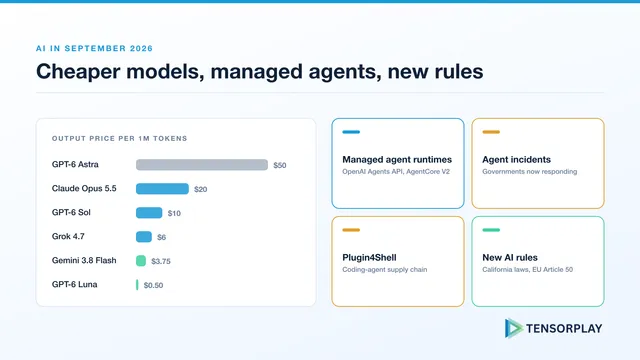
The AI news from September 2026 that matters to teams shipping AI: Claude Opus 5.5, GPT-6 Sol and Luna pricing, OpenAI's Agents API, Plugin4Shell, California's new AI laws and a migration checklist.
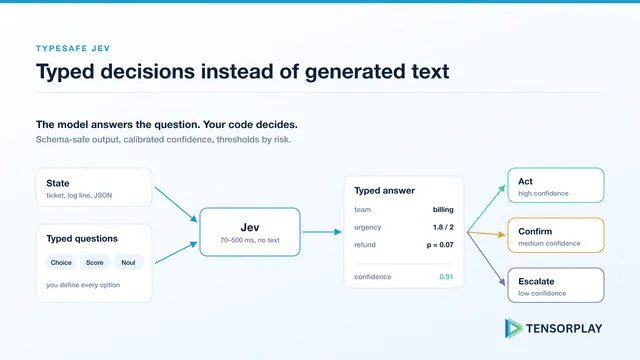
TypeSafe's Jev explained for production AI teams: typed Choice, Score and Noul answers, confidence gating, $0.042 per million input tokens, and the caveats in its benchmarks.
Improve model quality, control costs, and establish repeatable evaluation systems.
Discuss your projectBuild secure inference platforms with predictable performance and spend.
Discuss your project