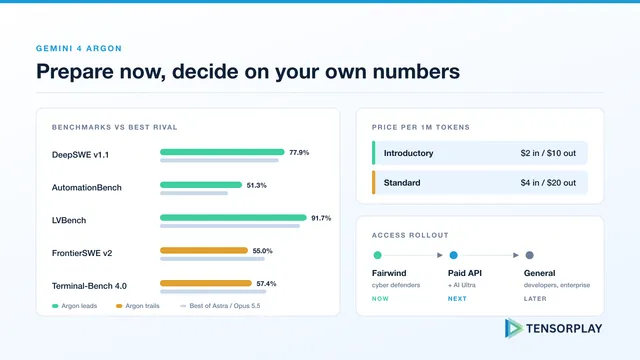
Gemini 4 Argon: Get Ready Before You Can Call It
Gemini 4 Argon for production AI teams: benchmarks against GPT-6 Astra and Opus 5.5, pricing that doubles after launch, 1M output tokens and a readiness plan.
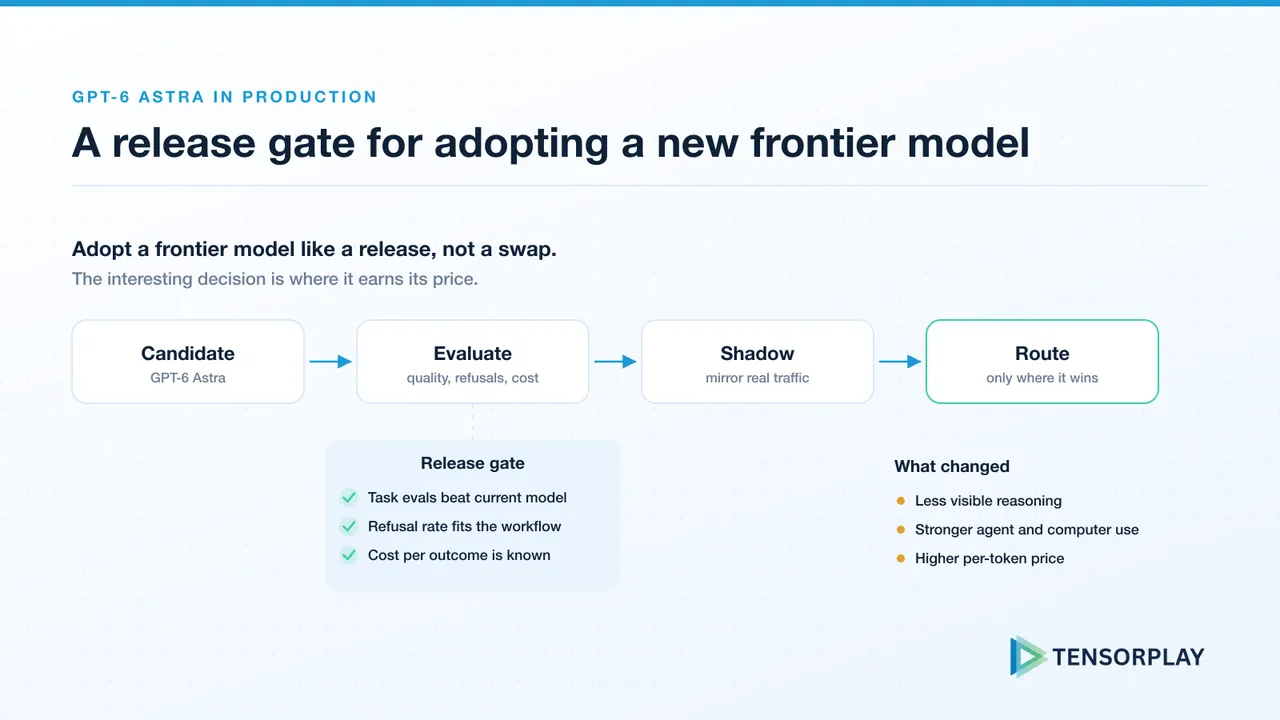
A more capable model with less visible reasoning, tighter access controls and a higher price changes how you should adopt it.
OpenAI announced GPT-6 Astra on 3 September 2026 and began rolling it out to Plus, Pro, Business and Enterprise plans and the API over the following days (TechCrunch, CNBC). OpenAI calls it the most capable model it has broadly deployed and its best model to date for software engineering, computer use and browsing.
For a team running AI in production, that is not a reason to change a model string and redeploy. It is a reason to run the same release process you would run for any dependency that changes behaviour, cost and risk at the same time. Four things about Astra deserve specific attention.
Astra uses what OpenAI describes as opaque recurrence: more of its reasoning happens outside the readable chain-of-thought tokens that earlier models produced. OpenAI’s chief scientist framed this as capable models needing fewer language tokens to do harder work. The practical consequence for engineers is that intermediate reasoning text is no longer a reliable debugging or audit surface.
Move your observability to the parts you can still see: the exact input, every tool call and its arguments, retrieved context, and the final output scored against task-specific criteria. If your LLM evaluation framework still leans on reading model reasoning, this is the moment to make it output-based. OpenAI’s own system card describes monitoring full trajectories for tool-using inference. Your traces should do the same.
Astra is the first OpenAI model to meet the Critical threshold for cybersecurity capability under the company’s Preparedness Framework. The version available to most customers declines certain cyber-related prompts, and deeper access for defensive work runs through trusted-access programmes.
If your product touches security, infrastructure, or code review, test the refusal boundary before migrating. A refused response is not an error in the HTTP sense, so it slips past retry logic and lands on a user as a failed task. Add refusal detection to your evaluation set, record refusal rate per workflow, and design a fallback path, whether that is a different model, a human queue, or a clearer message. Our AI threat model guide covers where these boundaries sit in a typical architecture.
The headline capability is autonomous computer and browser use combined with stronger long-horizon coding. That is valuable for agentic workflows, and it is exactly the capability that makes a loose permission model expensive. A model that can find and chain actions across systems needs tighter scopes, not broader ones.
Before giving Astra tools, apply the principles from building multi-agent systems for production: least-privilege credentials per tool, explicit allowlists for write actions, human approval on irreversible steps, and budgets on steps and spend per run. Treat the agent’s tool surface as an attack surface, because a more capable model probes it more effectively.
At launch the standard API price was reported at $10 per million input tokens and $50 per million output tokens (CNBC). Compared with current small and mid-tier models, that is an order of magnitude on output. Sending every request to Astra because it is the best model is how AI spend outgrows product value.
The right pattern is quality-aware routing, as described in our guide to reducing LLM inference costs. Build or refresh an evaluation set per workflow, find the cheapest model that clears the acceptance bar, and reserve Astra for tasks where its capability changes the outcome: complex code changes, multi-step research, or agent runs that fail on smaller models. Measure cost per successful outcome, not cost per token.
This is the same production readiness discipline that applies to any model change. The difference with Astra is that the upside and the failure modes are both larger, so skipping steps costs more.
If you are planning a migration to GPT-6 Astra or deciding where it belongs in your model mix, talk to Tensorplay about an evaluation and routing review. Our OpenAI integration work covers the production controls this release makes necessary.
Answers to common questions about this topic.
Gemini 4 Argon for production AI teams: benchmarks against GPT-6 Astra and Opus 5.5, pricing that doubles after launch, 1M output tokens and a readiness plan.

Tensorplay launches Rêver Studio, an online client gallery for photographers in India with 40+ themes, AI face grouping and AI culling that flags duplicates, blur and closed eyes. Start free with 5 GB.
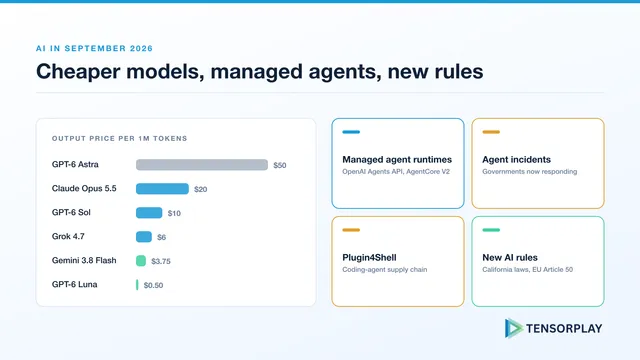
The AI news from September 2026 that matters to teams shipping AI: Claude Opus 5.5, GPT-6 Sol and Luna pricing, OpenAI's Agents API, Plugin4Shell, California's new AI laws and a migration checklist.
Turn prototypes into reliable, observable, and scalable AI systems.
Discuss your projectImprove model quality, control costs, and establish repeatable evaluation systems.
Discuss your project