Distance is not the problem. Ambiguity is.
Companies in the US, UK, Europe and the UAE have worked with engineering teams in India for decades, and the reasons are familiar: deep engineering talent, strong AI and data skills, and cost. Yet many teams still have an offshore engagement that disappointed them, and when you dig into why, it is rarely the distance itself.
It is usually ambiguity. Nobody agreed when the two teams would talk. Requirements lived in someone’s head. The offshore engineers were given tickets but not context. Access was granted on the shared admin account. Problems surfaced at the end of a sprint instead of the start.
All of those are fixable, and none of them depends on geography. This guide covers what we have learned about making an offshore AI team work well, from the side of the team doing the work.
Time zones: design the overlap deliberately
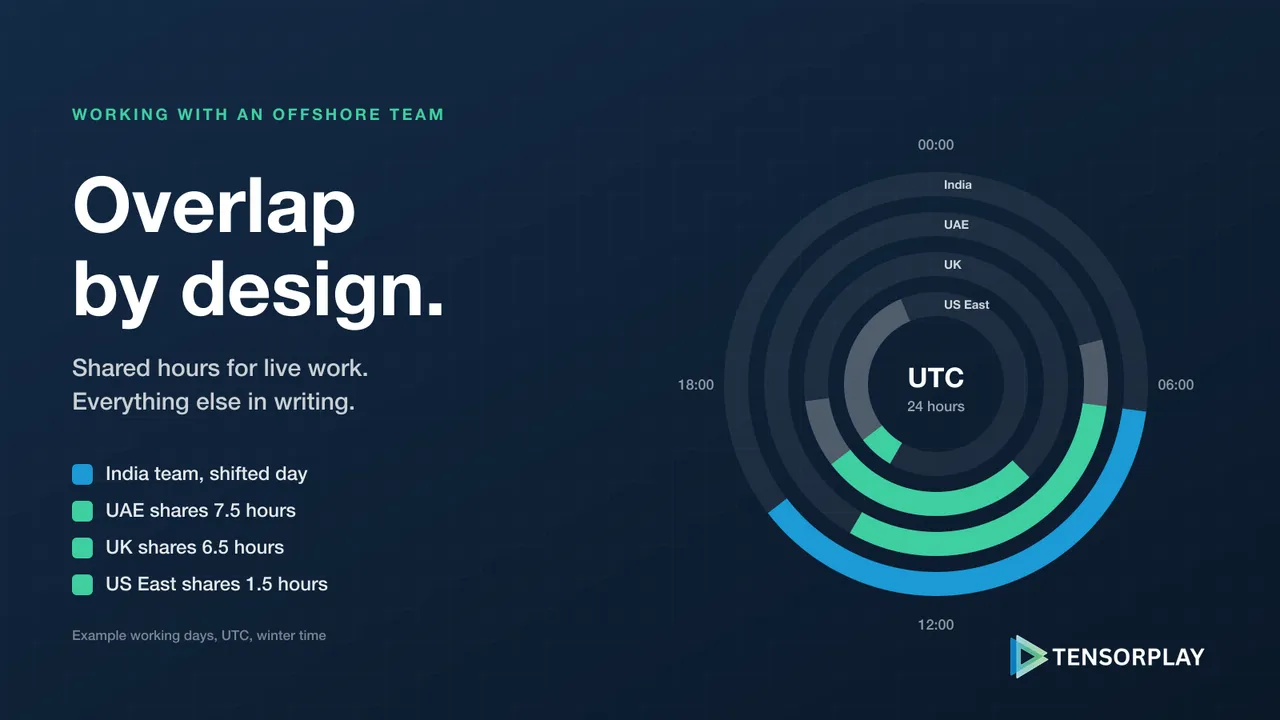
India Standard Time is UTC+5:30 all year. India does not observe daylight saving, so the gap with the UK, Europe and the US shifts by an hour twice a year.
| Your location |
India is ahead by |
A practical overlap window (your time) |
| UAE (GST, UTC+4) |
1.5 hours |
Most of the working day |
| UK (GMT / BST) |
5.5 / 4.5 hours |
Morning to early afternoon |
| Central Europe (CET / CEST) |
4.5 / 3.5 hours |
Morning to early afternoon |
| US Eastern (EST / EDT) |
10.5 / 9.5 hours |
Early morning |
| US Pacific (PST / PDT) |
13.5 / 12.5 hours |
Late afternoon or evening, by arrangement |
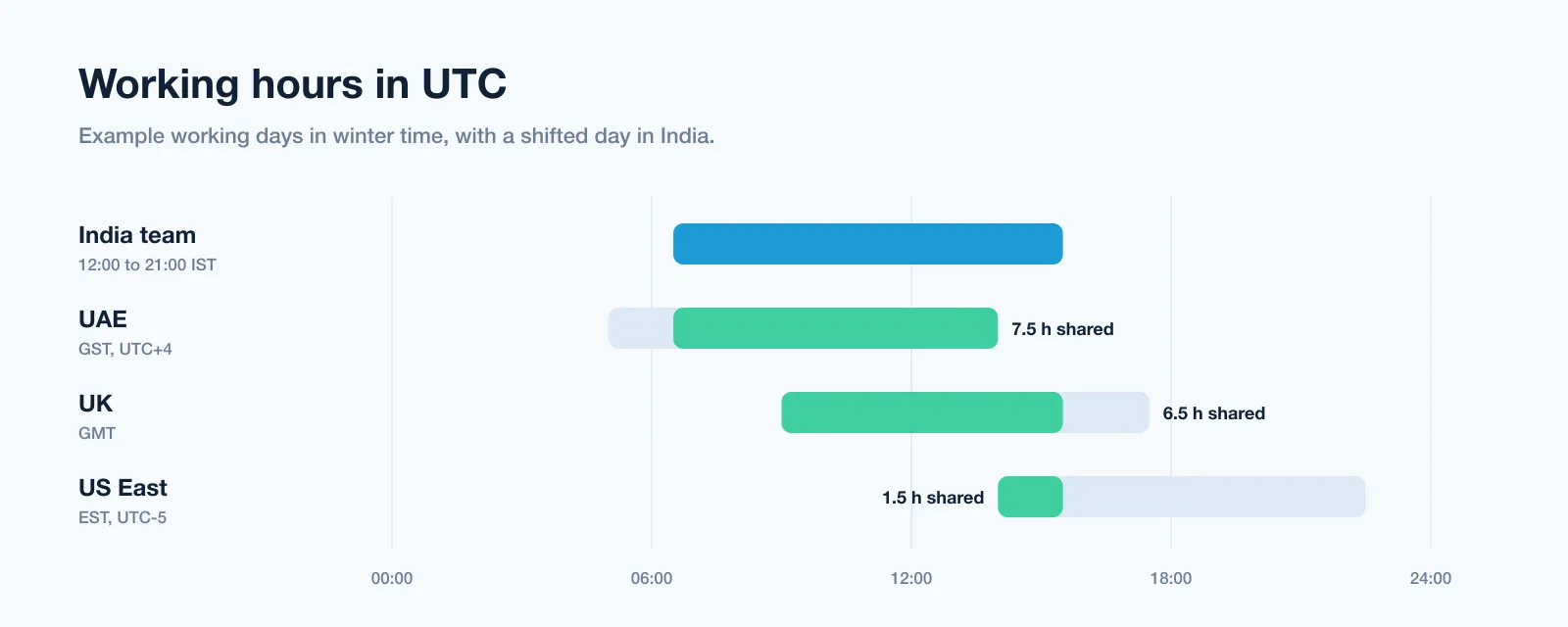
For the UAE, the time difference barely matters. For the UK and Europe, a shifted day on the India side gives you most of your morning and early afternoon. For the US East Coast, a later shift in India overlaps with your early morning, which is enough for a daily stand-up and unblocking. The US West Coast takes the most deliberate arrangement.
How much overlap is enough? For most teams, two to four hours of real-time overlap a day works well, provided the rest of the communication is written. More overlap does not fix a team that does not write things down.
How to use the overlap: stand-ups, unblocking questions, pairing on hard problems, design discussions and reviews. Not status updates. Status belongs in writing, where people in both time zones can read it when it suits them.
The time difference can help. With a clear handoff, work moves forward while you sleep. A US team that files questions and review comments at the end of its day can find them answered and fixed the next morning.
A communication rhythm that works
A simple rhythm, kept consistently, beats an elaborate one:
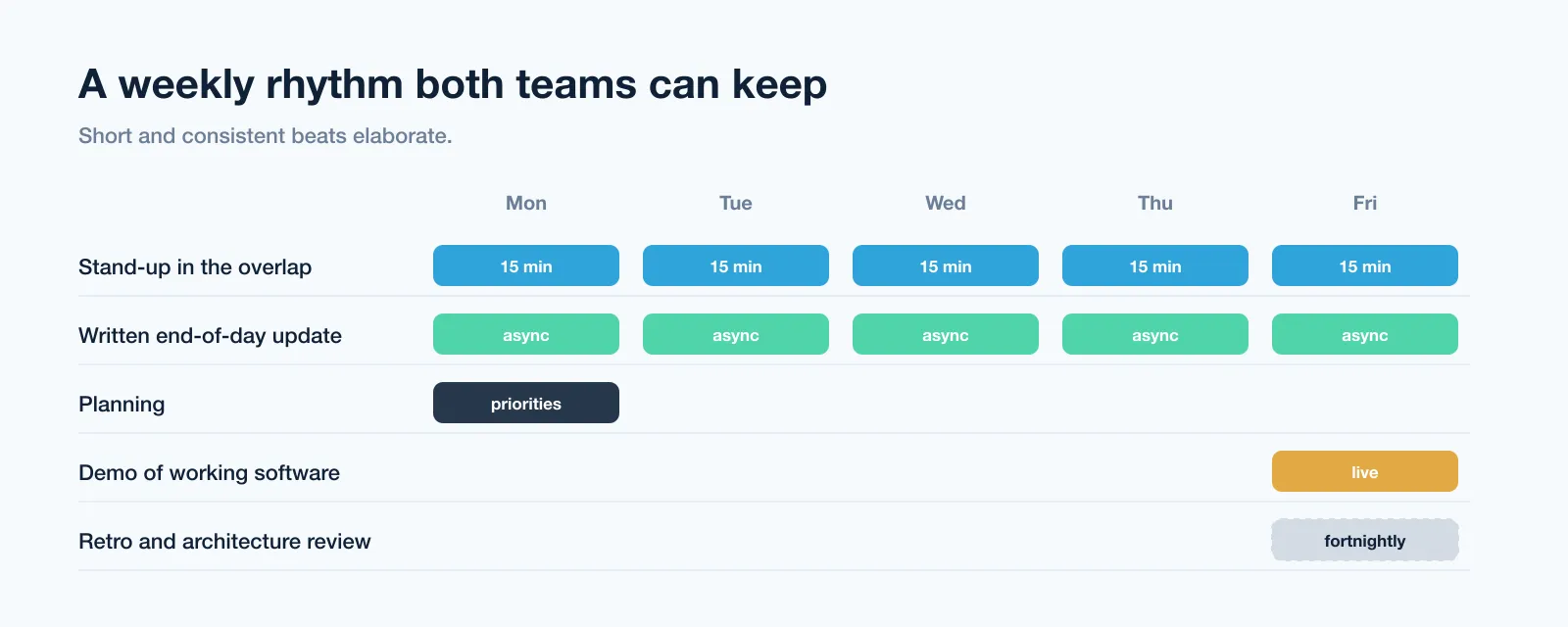
- Daily: a short stand-up in the overlap window, plus a written end-of-day update from the offshore team: what shipped, what is blocked, what questions need an answer.
- Weekly: a demo of working software. Not slides, not a status report: the actual product, running. A planning session to agree the next week’s priorities.
- Fortnightly or monthly: a retrospective on how the collaboration itself is working, and an architecture review with senior engineers from both sides.
- Always: decisions recorded in writing, in the tracker or a decision log, so nobody depends on remembering a call.
Give the offshore team a single named point of contact on your side who can make product decisions quickly, and expect a technical lead on their side who is accountable for delivery and quality. Most delays in offshore work are questions waiting for an answer.
Onboarding: the first two weeks decide the engagement
Treat offshore engineers the way you would treat a new hire, not a vendor:
- Context before tickets. Walk them through the product, the users, the business model and why the current priorities matter. Engineers who understand the “why” make better decisions without asking.
- Access on day one. Repositories, tracker, chat, documentation and a development environment, all through your own accounts. Waiting a week for access is the most common avoidable delay.
- A small real task first. Something that touches the codebase end to end and ships in the first week. It flushes out environment and access problems early.
- Pair with your engineers. A few sessions pairing with someone from your team transfer more knowledge than any document.
- Agree working practices explicitly. Branching, code review, definition of done, testing expectations and which AI tools may be used on your code.
Security, data and IP
These are the concerns we hear most often from companies outsourcing for the first time, and they have straightforward answers.
Contracts. The contract should assign the code, model weights, datasets and documentation produced for you to your company, typically on payment. Sign an NDA before sharing anything sensitive. It is normal for the provider to keep its own pre-existing tools and grant you a licence to use them, and to disclose any open-source components and licences.
Repositories and accounts. Code lives in repositories your company owns, in your organisation, from the first commit. Cloud resources live in your accounts. Engineers get access through your identity system, so you can see and revoke it at any time.
Least privilege. Engineers get the access their work needs, not admin rights by default. Production access, where needed at all, is limited, logged and reviewed.
Data handling. Keep production personal data out of development. Use synthetic or anonymised data for building and testing, and give access to real data only where the task requires it and your policies allow.
AI tools. Agree which AI coding assistants and model APIs may process your code and data, and make sure every change is reviewed by a human before it merges. This matters more for AI teams than most, because they use these tools heavily.
AI work needs more context, not less
Offshore AI teams face one extra challenge: AI quality is judged against domain knowledge. Whether a support agent’s answer is correct, or a document was classified properly, often takes a domain expert to tell. A team that only receives tickets cannot build that judgement.
So give AI teams:
- Access to domain experts on your side for regular review sessions.
- Real examples of good and bad outputs, which become the evaluation set that decides whether a change ships. Our LLM evaluation framework guide covers how to build one.
- Visibility of real usage, with appropriate privacy controls, so they can see how the system behaves with actual users and where it fails.
What to measure
Judge an offshore team on outcomes, not hours:
- Working software every week, demonstrated.
- Cycle time: how long work takes from starting to shipping.
- Escaped defects: problems users find that review and tests should have caught.
- For AI features: evaluation results over time, and cost per successful task.
- Questions and blockers: how quickly they are raised. A team that surfaces problems early is a team you can trust.
Working with Tensorplay
This is how we run our own engagements from Kerala. If you want a dedicated engineering pod or a scoped AI build, tell us where your team is and what you are building. If you are still choosing a partner, our guide on how to choose an AI development partner covers the questions to ask.