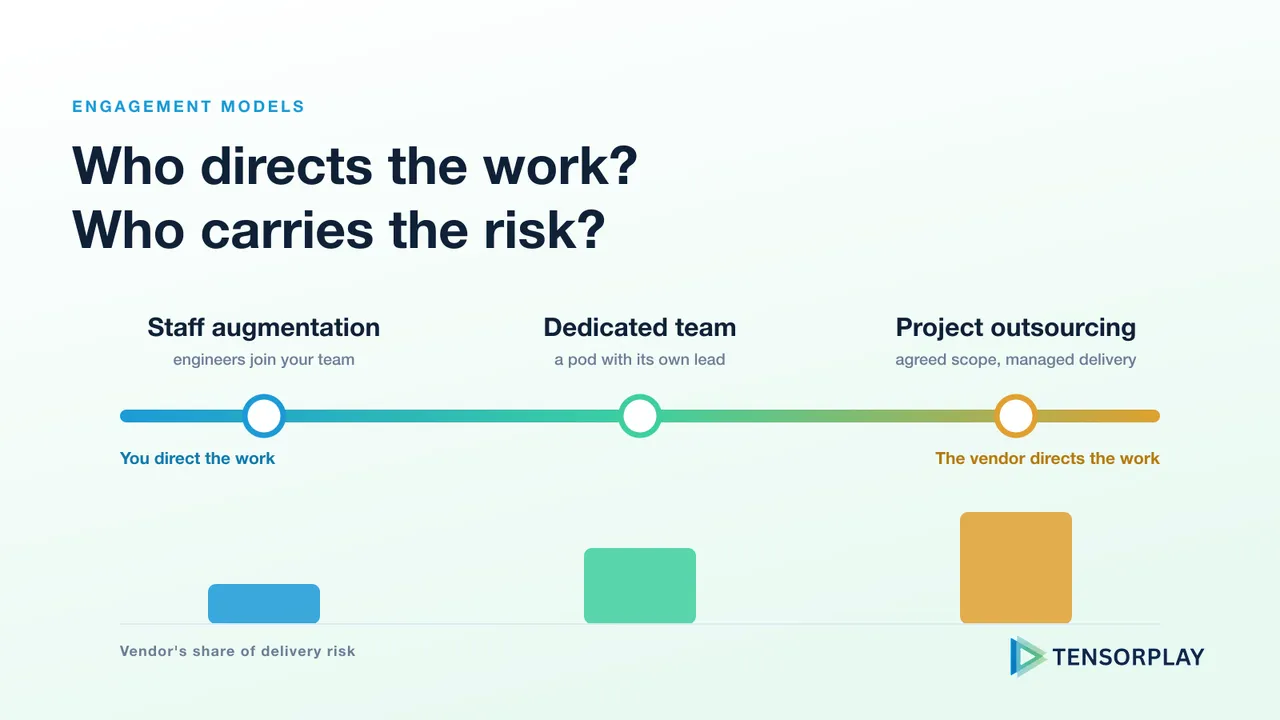
Three engagement models compared side by side: staff augmentation, project outsourcing and a dedicated team

Staff Augmentation vs Project Outsourcing vs Dedicated Team: Which Fits Your AI Work?

Three ways to bring in outside engineers, each with a different answer to who directs the work and who carries the risk. Here is how to choose for AI projects.

Three models, one real question

When you bring outside engineers into your product, you are choosing between three broad models: staff augmentation, project outsourcing and a dedicated team. Vendors use the terms loosely, so it helps to define them by the two questions that actually matter:

  1. Who directs the work day to day?
  2. Who carries the risk if delivery goes wrong?

Everything else — pricing, contracts, how much of your time it takes — follows from those two answers.

The three models at a glance

Staff augmentation Project outsourcing Dedicated team
Who directs the work You The vendor, against an agreed scope You set priorities; the team’s lead runs delivery
Who carries delivery risk Mostly you Mostly the vendor Shared
Typical pricing Monthly rate per engineer Fixed price or milestone-based Monthly retainer for the team
Your management time High: they work in your process Low day to day, high at scoping and review Medium: product direction, not task management
Flexibility High: add or remove people month to month Low: changes go through change requests High within the team; resizing takes some notice
Best when You have a team and process, but not enough people or skills The outcome is clear and self-contained You need a whole workstream owned, for months

Staff augmentation

External engineers join your team. They attend your stand-ups, take tickets from your backlog, work in your repositories and follow your engineering practices. The provider employs them and handles hiring, payroll and retention; you direct the work.

Choose it when:

  • You already have engineering leadership and a working delivery process.
  • The gap is capacity or a specific skill, such as an AI engineer who knows retrieval and evaluation.
  • You want to stay close to the code and make the technical decisions yourself.

Watch out for:

  • It only works if your process works. Augmented engineers amplify your existing team. If planning, code review or product direction is weak, adding people makes it louder, not better.
  • Onboarding is your job. Budget time from your own engineers for the first few weeks.
  • Seniority matters more than headcount. One engineer who can work independently is worth more than two who need constant direction.

Project outsourcing

You agree an outcome — an MVP, an integration, a migration, an audit — and the vendor takes responsibility for delivering it. The vendor staffs the project, manages it and hands over the result.

Choose it when:

  • The outcome is self-contained and you can describe what “done” looks like.
  • You do not have engineering leadership in-house to direct day-to-day work, or you do not want to spend it on this.
  • You need a predictable budget for a defined piece of work.

Watch out for:

  • Fixed scope fights with discovery. Every change becomes a change request. That is fine for well-understood work and painful for anything exploratory.
  • AI feasibility is rarely known up front. A fixed price for “build an agent that resolves our support tickets” hides a large unknown: whether your data and processes support it. Split it into a short feasibility phase first, then scope the build.
  • Handover is part of the deliverable. Agree the documentation, tests and knowledge transfer you will receive, or you will own a system nobody on your side understands.

Dedicated team

A stable team — usually several engineers with a technical lead — works only on your product for months or longer. You own the product direction and priorities; the team’s lead manages how the work gets done, runs the sprint and is accountable for quality. Some providers call this an engineering pod.

Choose it when:

  • You need a whole workstream or product area owned, not a few tickets done.
  • The work is ongoing, such as running and improving an AI product after launch.
  • You want the team’s knowledge of your product to compound over time.

Watch out for:

  • You still need a product owner. Someone on your side has to set priorities and make product decisions quickly.
  • Stability is the point. Ask how the provider handles people leaving, and whether the technical lead stays with you for the long term.
  • Integration with your own engineers. If you have an in-house team too, agree code review, architecture decisions and on-call responsibilities early.

Why AI work changes the choice

AI projects have a shape that does not fit neatly into one model:
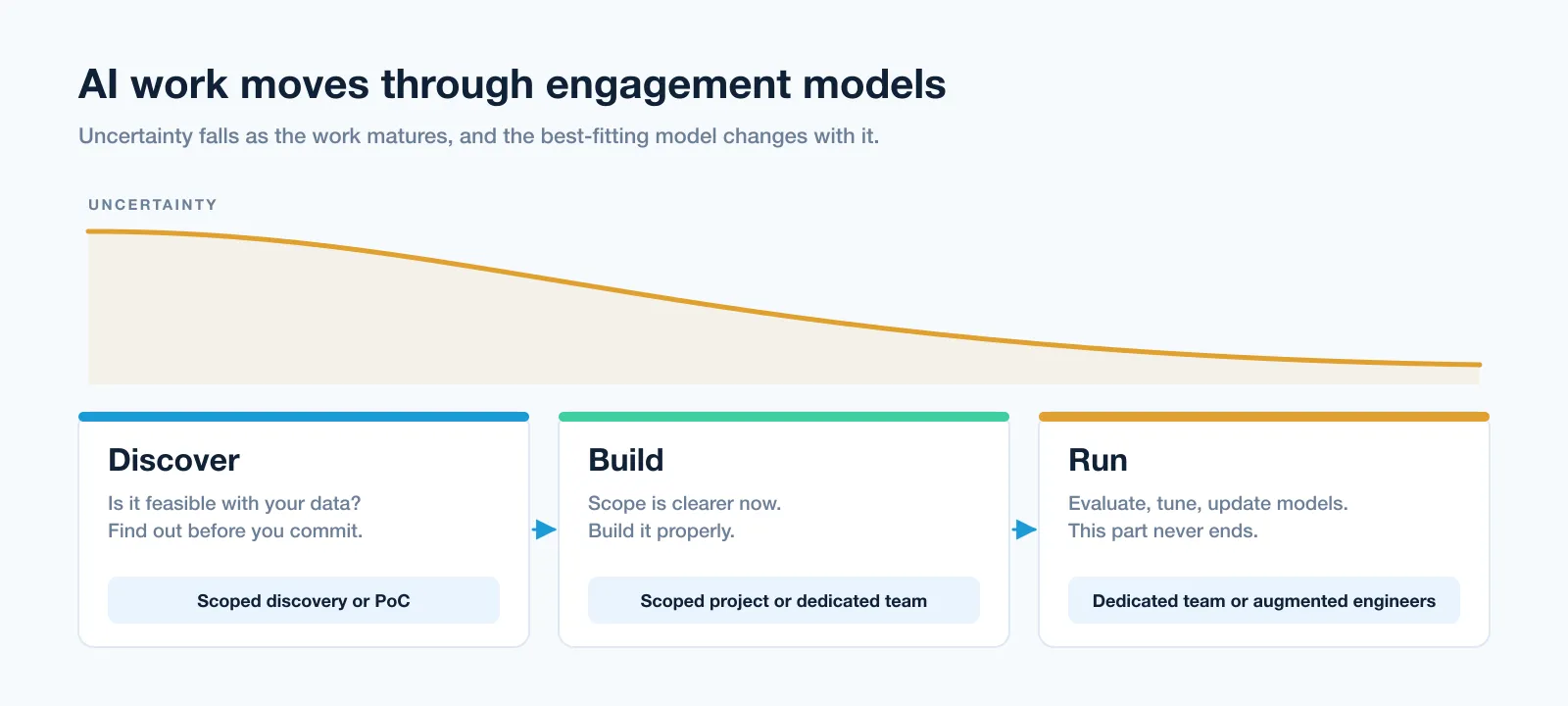
  • The start is uncertain. Whether the approach works depends on your data. That suits a short, scoped phase — a proof of concept, a feasibility study or a production readiness audit — with a clear decision at the end.
  • The middle is a build. Once feasibility is proven, the scope becomes clearer and a scoped project or a dedicated team can build it properly.
  • The end never really ends. AI systems need ongoing evaluation, prompt and model updates, cost tuning and monitoring. Model providers release new versions and retire old ones. That suits a dedicated team or augmented engineers who stay with the system.

AI work in three phases with falling uncertainty: discover, best fitted by scoped discovery or a proof of concept; build, by a scoped project or dedicated team; and run, by a dedicated team or augmented engineers

So the most common pattern we see for AI products is a sequence, not a single choice: scoped discovery, then a build, then a smaller dedicated team that keeps the system healthy and improving. Our PoC to production timeline describes how the phases fit together.

Five questions to decide

  1. Do you have engineering leadership with time to direct more people? If yes, augmentation is efficient. If no, choose outsourcing or a dedicated team with its own lead.
  2. Can you describe “done” precisely? If yes, a scoped project works. If not, start with discovery, or use a retainer.
  3. Is the work finite or ongoing? Finite work suits a project; ongoing work suits a team.
  4. How much does the knowledge need to stay with you? If the system is core to your business, keep your own people close to it, either by augmenting your team or by planning a handover from day one.
  5. How much uncertainty is there? The more there is, the shorter your first commitment should be. A short paid trial or discovery phase is cheap insurance.

Moving between models is normal

None of these choices is permanent, and good providers make it easy to move between them. A typical path: a founder outsources an MVP as a scoped project, keeps two of the same engineers on as a dedicated pod after launch, then adds a senior advisor for architecture reviews as their own team grows. The engineers already know the codebase, so nothing is lost in the transition.

How Tensorplay offers each model

Tensorplay offers all three. MVP and AI builds are scoped projects with agreed deliverables. Engineering pods cover both augmentation and dedicated teams: a single engineer in your team, or a pod with its own lead that owns a workstream. And our fractional CTO and advisory service helps when you need senior judgement on which model fits.

See our engagement models, or tell us about your project and we will recommend the model that fits your stage, even if that means a smaller engagement than you expected.

Frequently asked questions

Answers to common questions about this topic.

What is the difference between staff augmentation and project outsourcing?
With staff augmentation, external engineers join your team and you direct their work day to day. With project outsourcing, you agree an outcome and scope with a vendor, and the vendor manages the team and the delivery. Augmentation gives you control; outsourcing gives you a managed outcome.
What is a dedicated development team?
A dedicated team is a stable group of engineers, usually with its own technical lead, that works only on your product for an extended period. You set the priorities; the team's lead manages how the work gets done. It sits between staff augmentation and project outsourcing.
Which engagement model is best for AI projects?
Early AI work with uncertain feasibility suits a short scoped phase, such as a proof of concept or readiness audit, rather than a large fixed-price build. Once the approach is proven, a dedicated team or augmented engineers suit ongoing development, because AI systems need continuous evaluation and tuning after launch.
Is fixed price or time and materials better for outsourcing?
Fixed price works when the scope is well understood and unlikely to change, such as a defined MVP or an audit. Time and materials, usually as a monthly retainer, works better when requirements will evolve, which is the normal case for AI features and products after their first release.

For founders

MVP & Prototyping

Turn a raw idea into a working proof of concept or MVP in weeks, not months, so you can validate before you over-invest.

Book a discovery call

For AI builders

AI Engineering

AI-native applications, curated datasets and trained models, built by engineers who run AI systems in production.

Discuss your AI project

For scaling teams

Staff Augmentation

Vetted tech specialists who plug directly into your sprint cycle, without the hiring overhead.

Request engineers

For tech leaders

Fractional CTO & Advisory

Direct access to experienced engineering leaders for architecture reviews, engineering management and crisis unblocking.

Book a strategy session