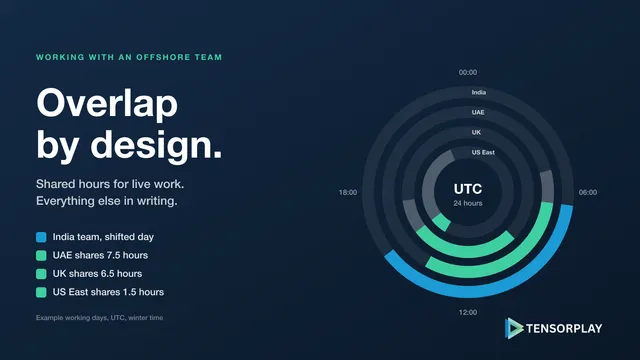
Working with an Offshore AI Team: Time Zones, IP and a Rhythm That Works
How to make an offshore AI or software team in India work from the US, UK, Europe or UAE: overlap hours, onboarding, security and IP, communication rhythm and what to measure.
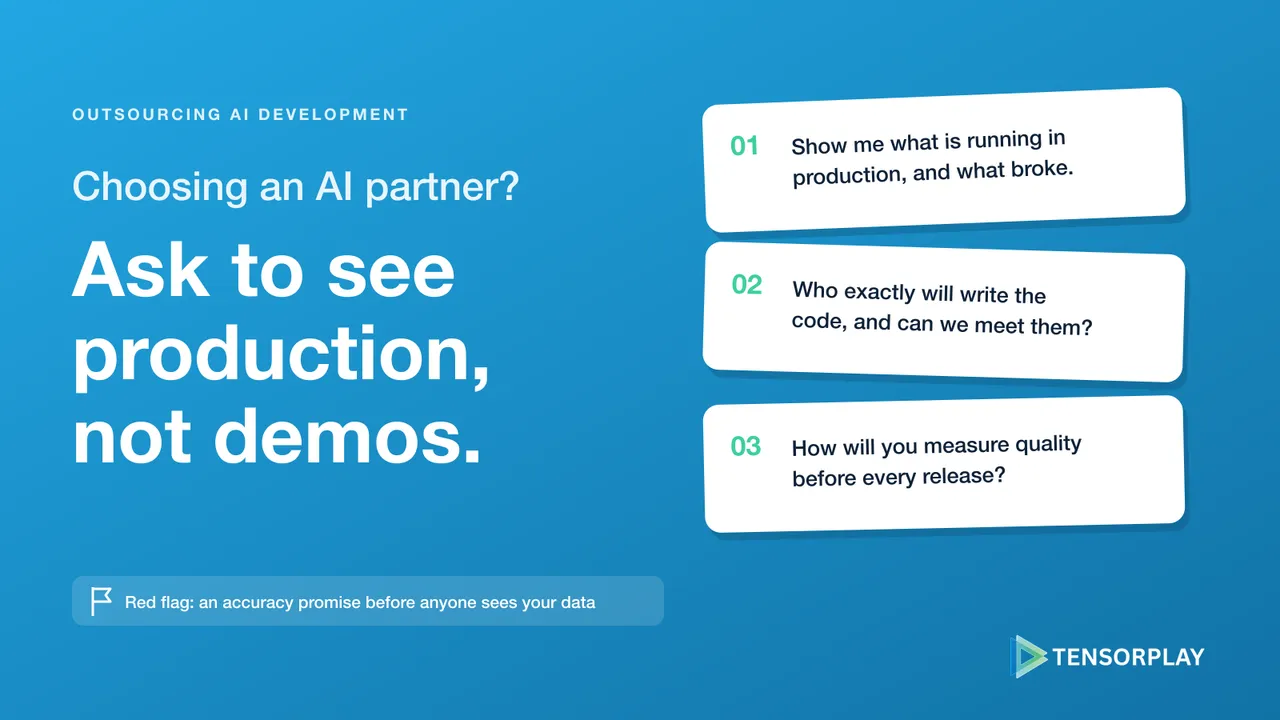
Outsourcing AI work is different from outsourcing a website. Here are the questions that separate teams who ship production AI from teams who ship demos.
When you outsource a website or a standard business application, you can describe what you want fairly precisely, and you can see whether you got it. AI work is different in three ways that matter when you choose a partner.
The outcome is uncertain at the start. Whether a model can classify your documents accurately enough, or an agent can resolve most of your support tickets, depends on your data. A good partner tells you how they will find out, not what the answer will be.
Quality is statistical, not binary. A traditional feature either works or it does not. An AI feature works on some percentage of inputs, fails in ways that can be subtle, and can change behaviour when the underlying model is updated. If a partner cannot explain how they will measure quality, they cannot tell you whether they have delivered.
The demo is the easy part. Almost anyone can now build an AI demo that impresses in a meeting. Very few teams have run AI systems under real load, with real users, for long enough to learn how they fail. That experience is what you are paying for.
So the questions you ask an AI development partner need to go beyond the usual ones about rates and availability.
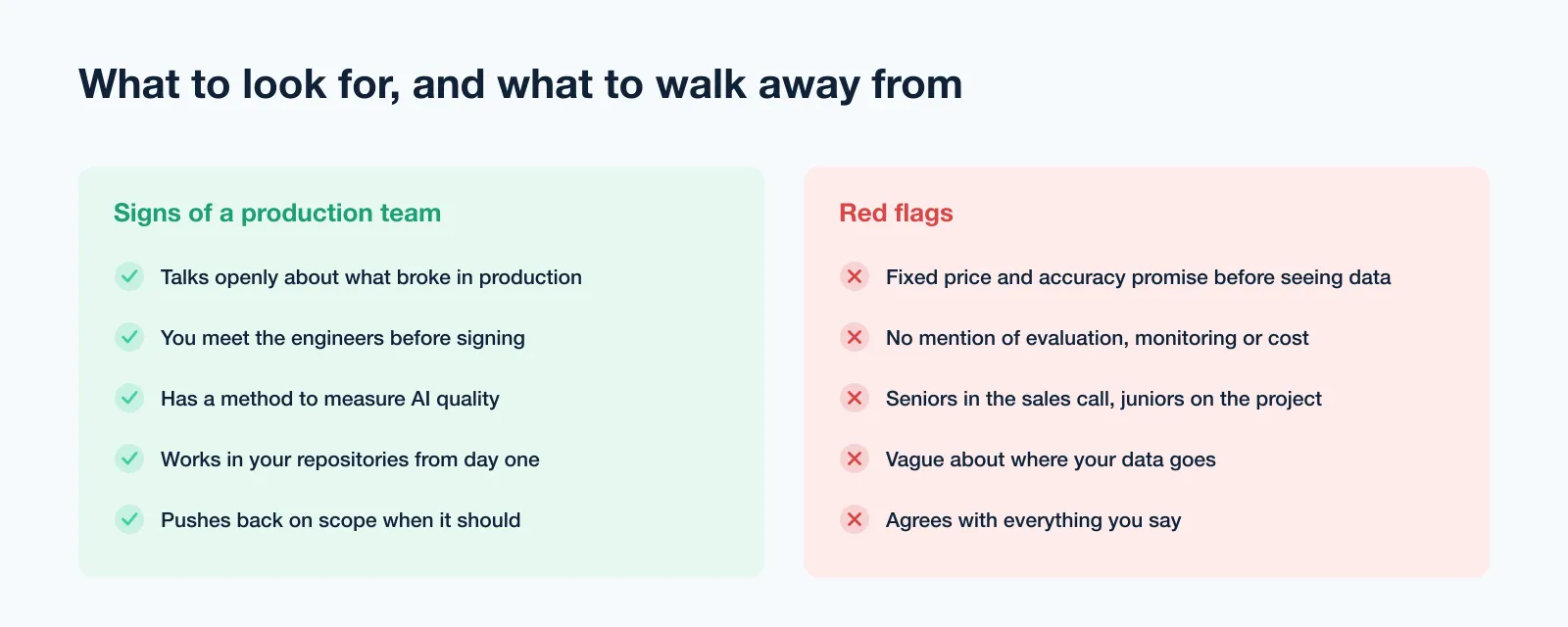
You want production systems, not prototypes or hackathon projects, and you want the partner to talk comfortably about failures. Every team that has run AI in production has stories about model updates that changed behaviour, costs that spiked or edge cases nobody predicted. A partner with no such stories has not run anything for long.
The people in the sales call are often not the people who write the code. Ask to meet the engineers who will actually be assigned, look at their experience, and ask what happens if one of them leaves during the engagement.
The answer you want involves an evaluation set built from real examples, agreed quality thresholds, and automated checks that run before every release. If the answer is “we test it manually” or “the model is very accurate”, keep looking. Our guide to building an LLM evaluation framework describes what good looks like.
AI projects depend on data, access to domain experts and decisions from your side. A good partner is specific about these dependencies up front and has a plan for the case where the data turns out to be insufficient: a smaller first scope, data collection, or a different approach.
Ask where your data will be stored and processed, whether production data will ever leave your environment, how access to your systems is granted and revoked, and whether engineers work in your accounts or theirs. For most clients the right answer is: in your repositories and your cloud accounts, with access you control.
Most good engineering teams now use AI coding assistants, and they should. The question is whether they follow your policy on which tools may see your code and data, and whether a human reviews every change before it merges. A partner that has not thought about this has not thought about your IP.
Ask how many hours of overlap you will have each day, who your single point of contact is, how often you will see working software, and how problems get escalated. We cover this in more depth in our guide to working with an offshore AI team.
See the section below. You should own what is built for you.
Ask what documentation, runbooks and knowledge transfer are included, and whether you could hand the system to another team or hire your own engineers to run it. A partner that makes itself hard to leave is a risk, however good it is.
The best partners talk clients out of projects, or out of parts of projects, when the approach is wrong or the value is not there. If every idea you raise is a good idea, nobody is protecting your budget.
You do not need an exotic contract, but it should cover:
The most reliable way to choose a partner is to work with them on something real.
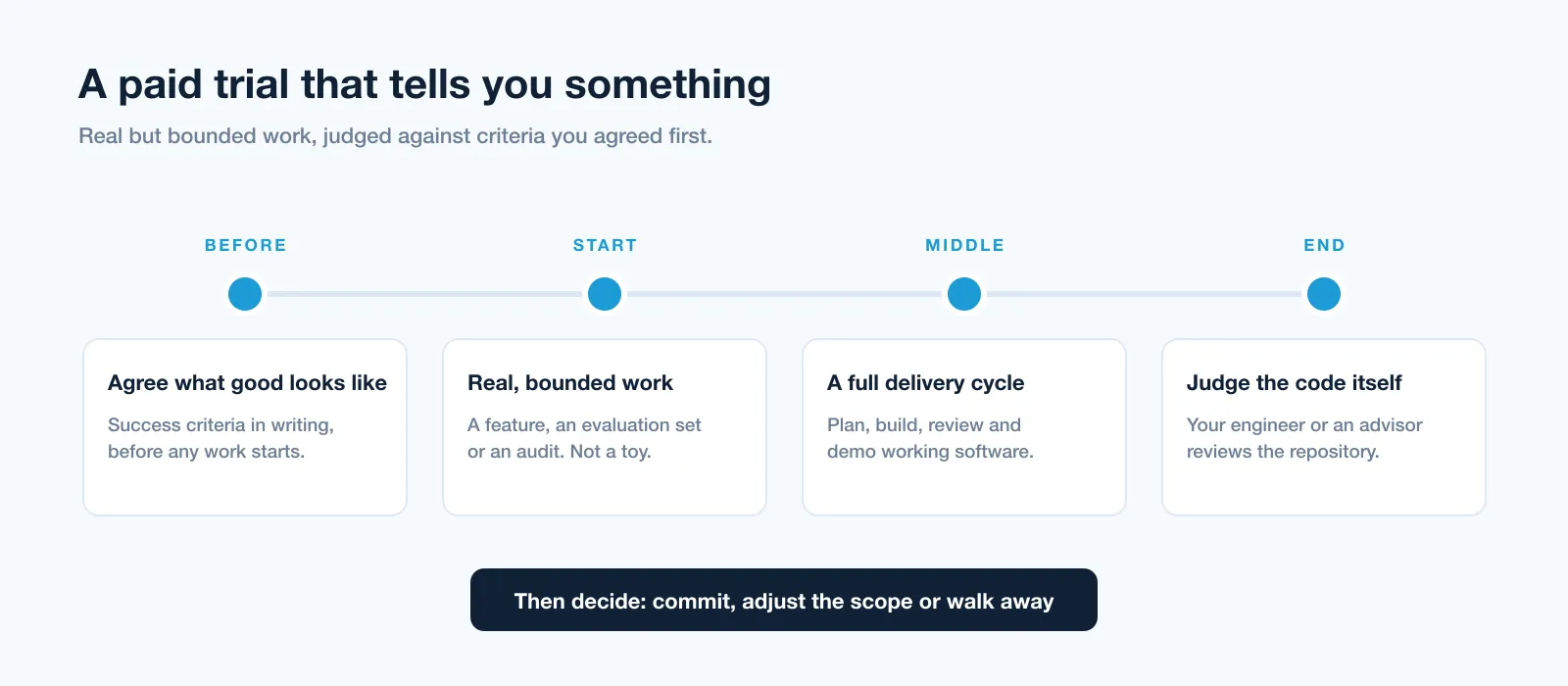
A good trial:
At the end, judge the code itself, not only the demo. Ask one of your own engineers, or an independent advisor, to review the repository: tests, structure, documentation and how decisions were recorded.
When comparing partners, score each from one to five on:
| Criterion | What good looks like |
|---|---|
| Production evidence | AI systems running for real users, with honest stories of failure |
| Evaluation | A clear method for measuring AI quality before every release |
| People | You have met the engineers who will do the work |
| Security and IP | Clear answers on data, access and ownership |
| Communication | Agreed overlap hours, a named contact and regular demos |
| Candour | They challenged at least one of your assumptions |
| Exit | A handover you could actually use |
If you are weighing up partners for an AI project, put these questions to us too. Tell us what you are building and we will tell you plainly whether we are a good fit, or see the projects we have shipped first.
Answers to common questions about this topic.
How to make an offshore AI or software team in India work from the US, UK, Europe or UAE: overlap hours, onboarding, security and IP, communication rhythm and what to measure.
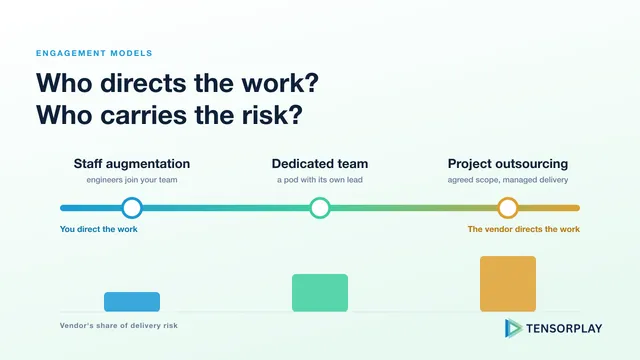
Staff augmentation, project outsourcing and dedicated teams compared for AI and software work: who directs the work, who carries delivery risk, how pricing works and when each fits.
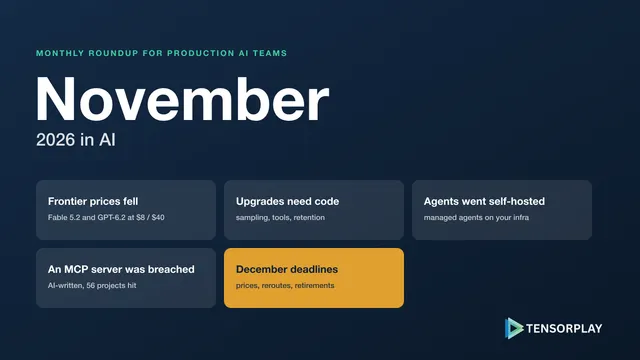
The AI news from November 2026 that matters to teams shipping AI: GPT-6.2 Astra, Claude Fable 5.2, Gemini 4 Neon and Hydrogen, Qwen4-Max, breaking API changes, the Mittwald MCP breach and December deadlines.
For founders
Turn a raw idea into a working proof of concept or MVP in weeks, not months, so you can validate before you over-invest.
Book a discovery callFor AI builders
AI-native applications, curated datasets and trained models, built by engineers who run AI systems in production.
Discuss your AI projectFor scaling teams
Vetted tech specialists who plug directly into your sprint cycle, without the hiring overhead.
Request engineersFor tech leaders
Direct access to experienced engineering leaders for architecture reviews, engineering management and crisis unblocking.
Book a strategy session