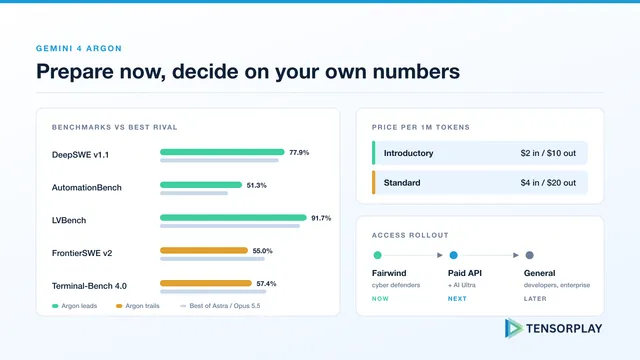
Gemini 4 Argon: Get Ready Before You Can Call It
Gemini 4 Argon for production AI teams: benchmarks against GPT-6 Astra and Opus 5.5, pricing that doubles after launch, 1M output tokens and a readiness plan.
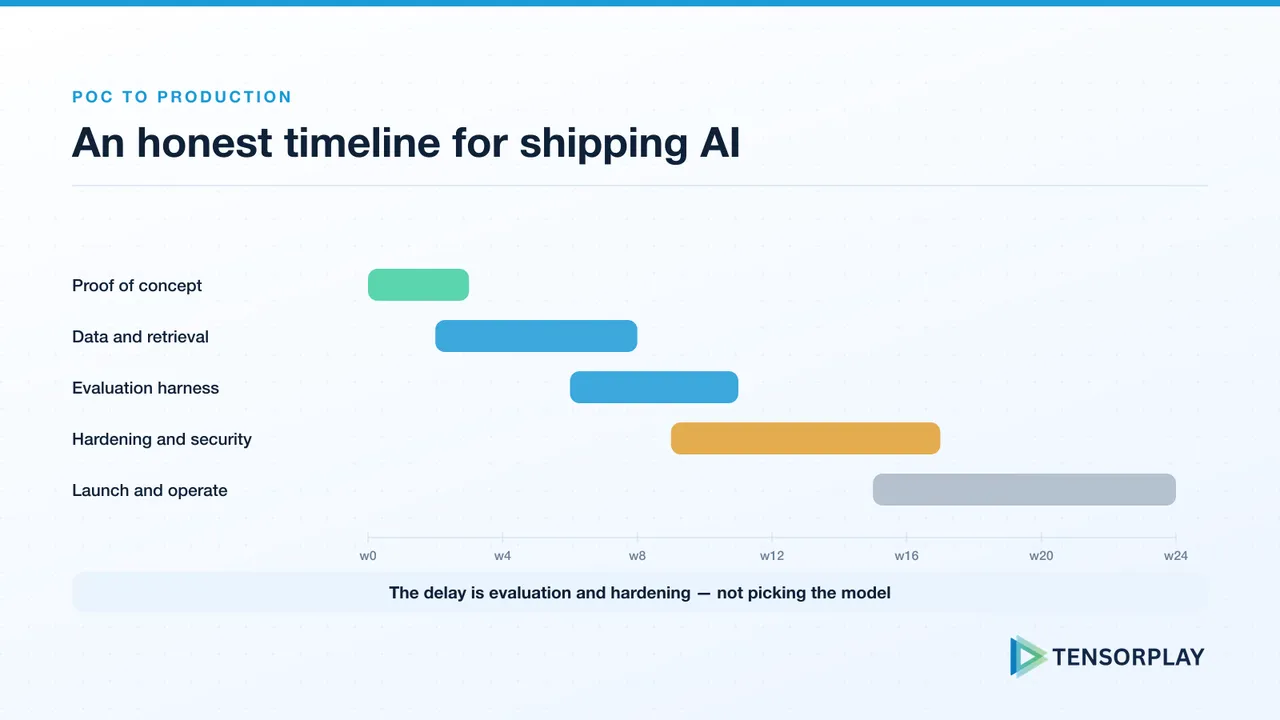
Why AI projects take longer than expected to productionize — and how to plan for it realistically.
One of the most frequent conversations we have with new clients starts the same way: “We have a working prototype. We expected it would take 2-4 weeks to put it into production. It’s been 4 months.”
This is almost universal. The gap between “it works on my laptop” and “it works reliably in production for real users” is much wider than most teams anticipate. Here’s an honest breakdown of why.
A prototype demonstrates that the AI approach works for the use case. It typically doesn’t have:
Each of these items is real engineering work. None of it is glamorous, but all of it is necessary. Our AI production readiness checklist turns this list into launch criteria you can check off.
Here’s a rough breakdown for a typical AI application going from a solid PoC to production:
Weeks 1-2: Architecture & Infrastructure Design the production architecture, set up cloud environments, establish CI/CD pipelines, choose and integrate the vector store, design the data model.
Weeks 3-5: Core Engineering Refactor the PoC code into a production service — proper error handling, structured logging, API design, authentication layer, streaming support.
Weeks 6-8: Quality & Reliability Build the evaluation suite using an LLM evaluation framework, run systematic prompt evaluation, implement monitoring and alerting, load testing and performance optimization.
Weeks 9-10: Security & Compliance Security review against an AI-specific threat model, data privacy audit, access control implementation, penetration testing if required.
Weeks 11-12: Deployment & Rollout Staged rollout with feature flags, monitoring ramp-up, documentation, and team training.
For complex multi-agent or multi-modal systems, add 4-8 weeks to each phase.
The fastest teams we work with share some common traits:
The slowest teams underestimate the non-model work and try to shortcut the infrastructure phase — which consistently leads to painful rewrites.
If you’re planning an AI productionisation project and want a realistic timeline estimate for your specific case, talk to Tensorplay about your roadmap.
Answers to common questions about this topic.
Gemini 4 Argon for production AI teams: benchmarks against GPT-6 Astra and Opus 5.5, pricing that doubles after launch, 1M output tokens and a readiness plan.

Tensorplay launches Rêver Studio, an online client gallery for photographers in India with 40+ themes, AI face grouping and AI culling that flags duplicates, blur and closed eyes. Start free with 5 GB.
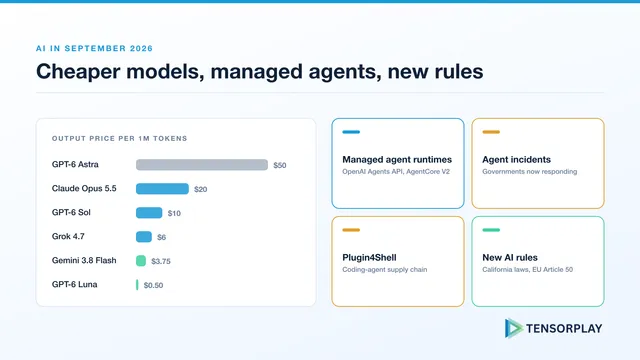
The AI news from September 2026 that matters to teams shipping AI: Claude Opus 5.5, GPT-6 Sol and Luna pricing, OpenAI's Agents API, Plugin4Shell, California's new AI laws and a migration checklist.
Turn prototypes into reliable, observable, and scalable AI systems.
Discuss your project