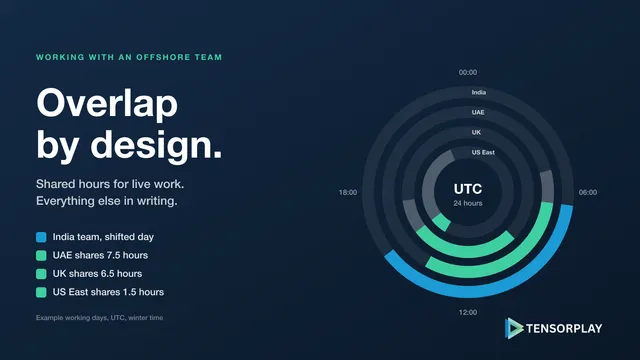
Working with an Offshore AI Team: Time Zones, IP and a Rhythm That Works
How to make an offshore AI or software team in India work from the US, UK, Europe or UAE: overlap hours, onboarding, security and IP, communication rhythm and what to measure.
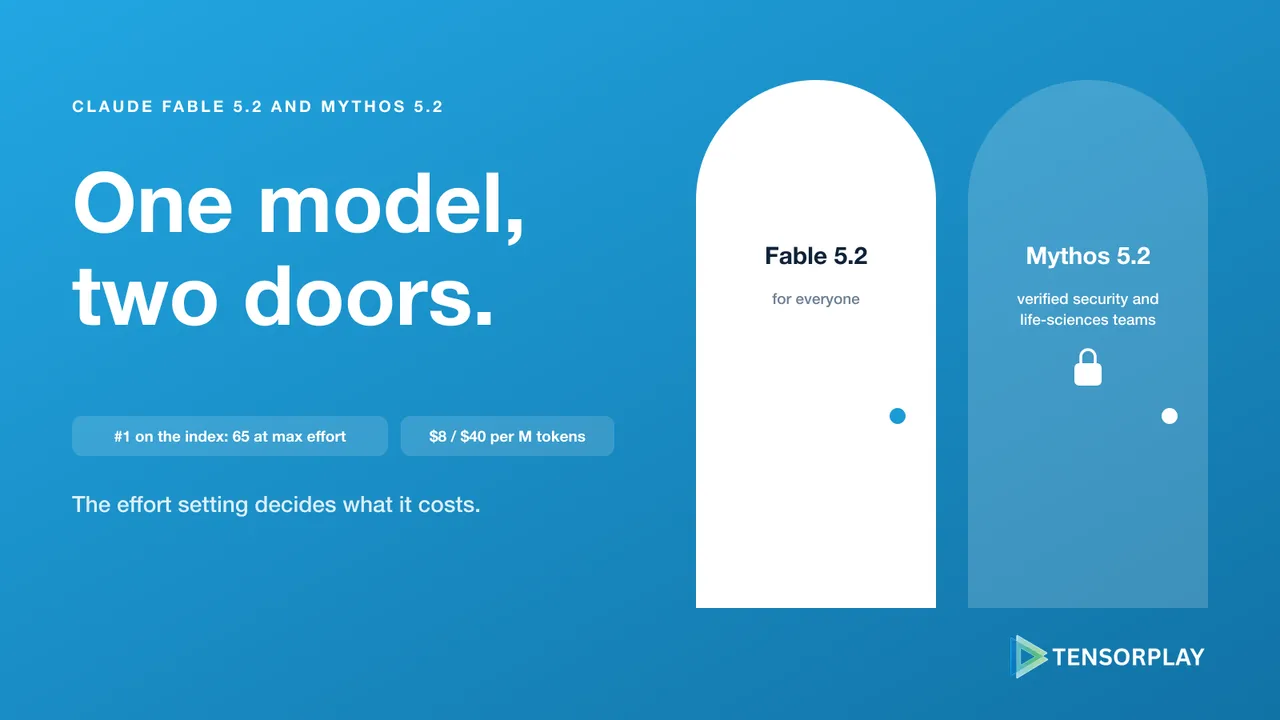
Anthropic's new top model ships twice: Fable 5.2 for everyone, Mythos 5.2 for verified security and life-sciences teams. It leads the Artificial Analysis Intelligence Index at a 20% lower price. At max effort it is also the most expensive model on the index per task, but at the default High effort it beats every rival for less than Opus 5.5 costs.
Anthropic released Claude Fable 5.2 and Claude Mythos 5.2 together on 9 November 2026 (Anthropic). In Anthropic’s words, “Claude Fable and Claude Mythos are the same underlying model.” The difference is the safeguards, and therefore who can use each one.
| Claude Fable 5.2 | Claude Mythos 5.2 | |
|---|---|---|
| Who can use it | Everyone | Organizations accepted into the Cyber or Life Sciences Verification Program |
| Safeguards | Classifiers block high-risk cyber work and most research-biology tasks | Without certain cyber and biology safeguards, for vetted security and biomedical work |
| API model ID | claude-fable-5-2 |
claude-mythos-5-2 |
| Price per 1M tokens | $8 in / $40 out | $8 in / $40 out |
| Context / max output | 1M / 128K | 1M / 128K |
| Fast mode | Claude API, Claude Code, Google Cloud, Microsoft Foundry | Claude API and other listed platforms, for verified organizations only |
Three things matter most for production teams:
Anthropic is also clear that neither model is meant to replace Opus 5.5 by default: “For most coding and knowledge tasks, we recommend that users start with Claude Opus 5.5, our strongest daily driver.” Its docs say to move to Fable 5.2 “when your evals on a Claude Opus model at higher effort still don’t meet your requirements” (What’s new in Claude Fable 5.2).
Short on time? Watch the one-minute summary.
Anthropic published a launch table against the 5.1 models, Opus 5.5, GPT-6 Astra and Gemini 4 Carbon. These are Anthropic-run results. Scores for the Claude models are with safeguards on and every model is at its highest available effort unless noted (Anthropic; methodology in the system card).
| Benchmark | Fable 5.2 | Fable 5.1 | Opus 5.5 | GPT-6 Astra | Gemini 4 Carbon |
|---|---|---|---|---|---|
| FrontierCode 2.0 (agentic coding) | 49.1% (xhigh) | 32.4% | 45.5% | 42.8% | 41.1% (medium) |
| FrontierSWE v2 | 69.9% | 56.3% | 62.3% | 65.5% | 61.2% |
| AutomationBench (business workflows) | 51.4% | 31.4% | 42.5% | 41.4% | 53.9% |
| Terminal-Bench-Science 0.1 | 74.6% | 52.6% | 58.7% | 68.1% | 64.8% |
| WANDR, relaxed (agentic search) | 82.1% | 68.7% | 72.3% | — | — |
| OSWorld 2.1, offline set (computer use) | 89.3% | 83.5% | 87.2% | 79.5% | 81.5% |
| RoboDojo Sim (robotics, Anthropic-run) | 64.9% | 27.6% | 39.4% | 29.8% | — |
| AA-Briefcase v1.1, rubric (knowledge work) | 66.1% | 61.5% | 61.2% | 52.0% | 61.8% |
| Remote Labor Index | 41.3% (high) | 17.9% | 21.3% | 20.8% | — |
| Humanity’s Last Exam (with tools) | 74.2% | 65.6% | 67.7% | 57.2% | — |
| Chartography (no tools) | 73.4% | 44.8% | 64.4% | 71.0% | 72.5% |
What stands out:
These rows test work that Fable 5.2’s safeguards block, so Anthropic ran them on Mythos 5.2. It compares Mythos 5.2 with Mythos 5.1, Opus 5.5 with its safeguards off, and, on one row, GPT-6 Cyber.
| Benchmark | Mythos 5.2 | Mythos 5.1 | Opus 5.5 (no safeguards) | GPT-6 Cyber |
|---|---|---|---|---|
| CyScenarioBench (cybersecurity) | 76.3% | 61.7% | 67.6% | 61% |
| CVE Rediscovery (cybersecurity) | 89.6% | 78.3% | 81.3% | — |
| De novo binder design, 24 hr (protein) | 85.1 | 79.1 | 82.6 | — |
On CyScenarioBench, Anthropic notes that “each lab’s scores are based on unique tasks”, so the GPT-6 Cyber figure is not a like-for-like comparison. Mythos 5.2 also scores 75.3% on Terminal-Bench-Science, slightly above Fable 5.2’s 74.6%.
Anthropic calls Mythos 5.2 “our most capable model for cybersecurity engineering”. Its claims, and their limits:
How to get it:
For everyone else, the practical point is the same one we made about Gemini 4 Carbon. Vulnerability-finding models are now gated by vetting, not by price. Assume attackers will eventually have similar capability, keep patch windows short, and keep your AI application threat model current.
Vendor tables pick their own rivals and settings, so we also check Artificial Analysis, which runs every model on the same evaluation suite. Artificial Analysis is the original publisher of its own index and cost figures. For Anthropic’s prices, limits and benchmarks we use Anthropic’s pages. Artificial Analysis has evaluated Fable 5.2 but does not list Mythos 5.2, which is only available to verified organizations. The figures below are Fable 5.2’s.
On the Artificial Analysis Intelligence Index v5.0.1 (nine evaluations, including AA-Briefcase, FrontierCode-AA 2.0 and Terminal-Bench 4.0), Fable 5.2 at max effort scores 65, first of the 74 models in its ranking. Gemini 4 Carbon is second with 60, Claude Opus 5.5 third with 59 and GPT-6 Astra fourth with 57. Fable 5.1 scores 49.
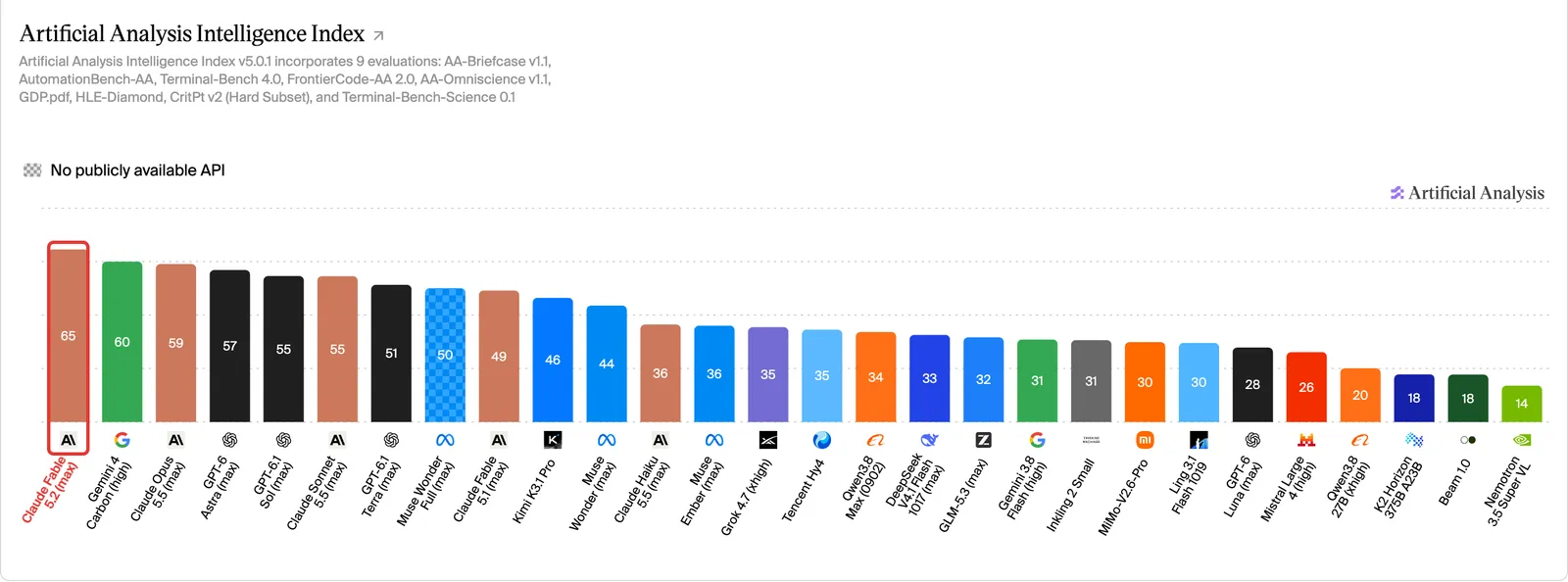
Source: Artificial Analysis, Artificial Analysis Intelligence Index v5.0.1. Screenshot taken 12 November 2026.
Carbon scored 59 on v5.0 when we wrote about it on 31 October. It scores 60 on the current v5.0.1.
The cost chart shows the other side. Artificial Analysis measures $26.54 per Intelligence Index task for Fable 5.2 at max, the highest on the chart. That is about twice Fable 5.1 ($12.99), and more than 2.5 times Opus 5.5 ($10.04) and 3.4 times Gemini 4 Carbon ($7.76).
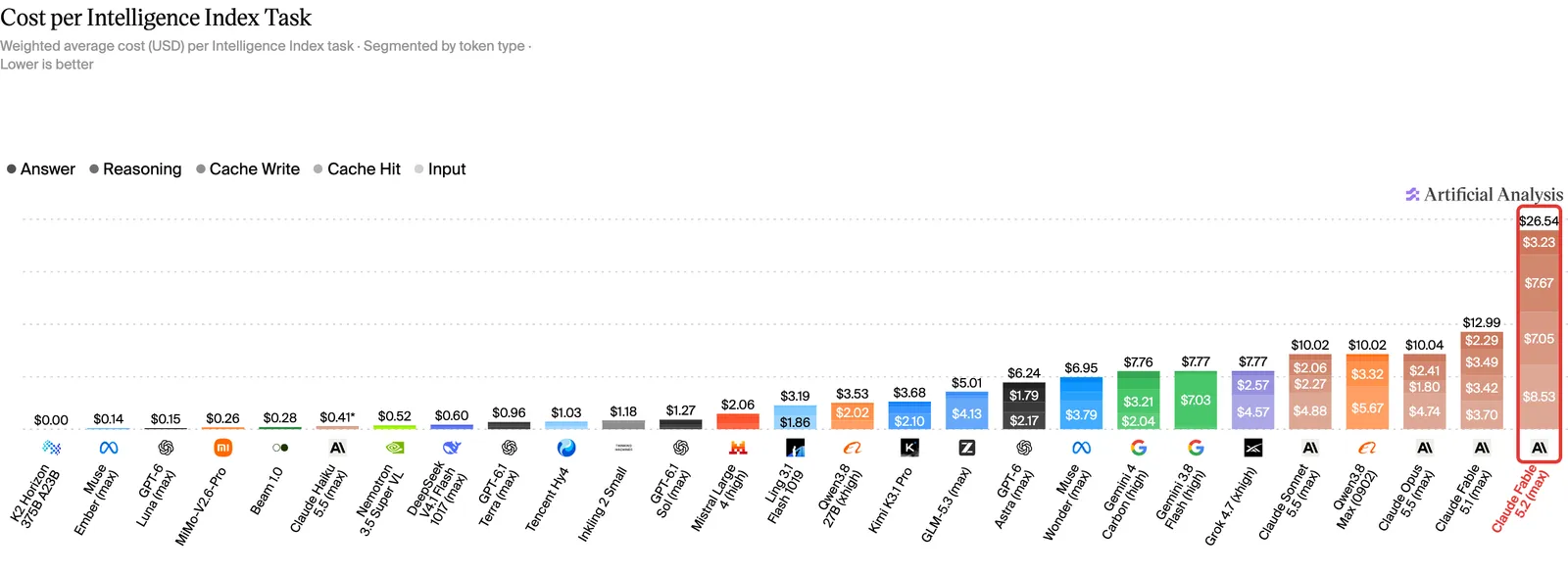
Source: Artificial Analysis, Cost per Intelligence Index Task. Screenshot taken 12 November 2026.
A lower price per token does not make Fable 5.2 cheaper to run at max effort, because it uses far more tokens. At max, Artificial Analysis counted 275 million output tokens across the index, against a median of 72.8 million for comparable models. It took 47.5 minutes per task, against a median of 12.8.
Artificial Analysis ran Fable 5.2 at all five effort levels (release page). Here they are alongside the strongest rivals at their default settings on the index:
| Model and effort | Intelligence Index | Cost per task | Time per task |
|---|---|---|---|
| Fable 5.2 (max) | 65 | $26.54 | 47.5 min |
| Fable 5.2 (xhigh) | 62 | $14.83 | 26.4 min |
| Fable 5.2 (high) | 62 | $9.08 | 16.7 min |
| Gemini 4 Carbon (high) | 60 | $7.76 | 25.7 min |
| Claude Opus 5.5 (max) | 59 | $10.04 | 25.0 min |
| GPT-6 Astra (max) | 57 | $6.24 | 24.8 min |
| Fable 5.2 (medium) | 56 | $3.80 | 7.7 min |
| Fable 5.2 (low) | 54 | $3.10 | 6.2 min |
Source: Artificial Analysis, Intelligence Index v5.0.1, retrieved 12 November 2026.
By our own calculation from these figures:
This matches Anthropic’s own guidance. The API default effort is high, and the docs say to “start there, because most of the gain in capability is already present at high”, to step up to xhigh only “where you’ve measured a gain”, and to keep max “for measuring the model’s ceiling”. Anthropic’s launch charts point the same way. On FrontierCode 2.0, Fable 5.2 at High scores 45.3% against Opus 5.5’s best of 45.5%, for “roughly half the cost per task”. On Humanity’s Last Exam it matches Opus 5.5’s top score at Low effort for under a tenth of the cost. Anthropic’s CVE Rediscovery chart shows the same pattern for Mythos 5.2: it beats Mythos 5.1 and Opus 5.5 at every effort level, so the most expensive setting is not required to see the gain.
One caution on Low and Medium: Anthropic notes that on long, multistep tasks the model “sometimes ends a turn with a list of what remains” or an offer to continue, and that this “occurs more often at low and medium effort”. Cheap runs that stop early are not cheap. Measure cost per completed task, not cost per request.
Fable 5.2 and Mythos 5.2 have identical prices (Anthropic pricing):
| Item | Fable 5.2 and Mythos 5.2 | Fable 5.1 and Mythos 5.1 |
|---|---|---|
| Input / output, per 1M | $8 / $40 | $10 / $50 |
| Cache reads, per 1M | $0.20 | $0.25 |
| 5-minute cache writes | $10 | $12.50 |
| Batch, per 1M | $4 / $20 | $5 / $25 |
| Fast mode, per 1M | $16 / $80 | not offered |
claude-fable-5-2, Claude Platform on AWS, Amazon Bedrock (global.anthropic.claude-fable-5-2), Claude Models on Google Cloud and Microsoft Foundry (model page). Mythos 5.2 is on the Claude API as claude-mythos-5-2, Amazon Bedrock, Claude Models on Google Cloud and Microsoft Foundry.Changing the model ID is not the only change. Anthropic lists four breaking changes from the 5.1 models (What’s new):
system or tools mid-conversation, any thinking block sent back after that point fails the preserved thinking prefix check with a 400 error. On Fable 5.1 this applied only to accounts created on or after 31 August 2026, so an integration that worked on an older account can fail after the switch. Mythos 5.1 already enforced it on every account on the Claude API. Anthropic says the change also protects against distillation.computer_toolset_20260801. The earlier computer_20251124 tool returns a 400 error everywhere except Amazon Bedrock.If you are coming from Opus 5 or older, two more rules apply. Thinking cannot be turned off (budget_tokens and disabled return a 400 error), and forced tool_choice (any or tool) returns a 400 error. Use strict: true tools or structured outputs instead. Requests through Claude Code, claude.ai, Managed Agents and the Claude Agent SDK need no changes.
Two behaviour changes are worth checking in your prompts. A line such as “answer directly without deliberating” no longer stops the model from thinking at medium effort and above. Use a lower effort level for easy turns instead. And the model can run long stretches of tool calls with little user-facing text, so agent UIs need progress updates.
Fable 5.2 keeps Fable 5.1’s cyber and biology safeguards. In early testing across claude.ai, Claude Code and Cowork, Anthropic saw about 55% fewer blocks than on Fable 5.1: about 60% fewer in cybersecurity and 40% fewer in biology. In Anthropic’s apps, a blocked query is answered by Opus 4.8 for cybersecurity and Opus 5 for biology. On the API, a blocked request returns stop_reason: "refusal", and server-side fallback (beta) can retry it automatically on Opus 4.8 or Opus 5.
Anthropic ran its alignment tests on Mythos 5.2, because the version without the cyber and biology blocks gives the most complete view of behaviour. It expects Fable 5.2 to behave similarly. The results are vendor-run:
If you are a Mythos 5.2 customer, the sandbox result matters most. Mythos 5.2 does not have Fable’s blocks, so run it with least-privilege credentials and nothing sensitive reachable from its sandbox. For both models, keep human approval for irreversible actions.
Anthropic’s showcase results are long, multi-agent runs. One engineer had Fable 5.2 build a prototype operating system from an empty folder. It coordinated over 1,000 subagents for eight days. A team of 1,000 Fable 5.2 agents formalized Fermat’s Last Theorem in Lean in 30 hours, given 60 target statements and 47 proved lemmas from an earlier attempt. With the same setup, Opus 5.5 completed 26% in 18 hours and barely moved after that. Uber’s Andrew Mager describes a 10–12 hour security audit that sent out about 170 reviewer agents.
Runs like these are where these models earn their price, and where costs can grow without limit. Anthropic’s docs warn that “subagents can account for a large part of what a session costs”.
computer_toolset_20260801 and a 5.2 advisor.stop_reason before reading content, and enable fallbacks if your domain touches security or biology.Fable 5.2 is the strongest model on the independent index today, and at the default High effort it is better value than Opus 5.5 at max. Mythos 5.2 gives verified security and life-sciences teams the same model without the blocks. At max effort it is the most expensive model on the chart, so the choice of effort level will affect your bill more than the price cut. If you want help with the evaluation, routing and cost controls that turn a new model into a measured upgrade, talk to Tensorplay about a model readiness review.
Answers to common questions about this topic.
How to make an offshore AI or software team in India work from the US, UK, Europe or UAE: overlap hours, onboarding, security and IP, communication rhythm and what to measure.
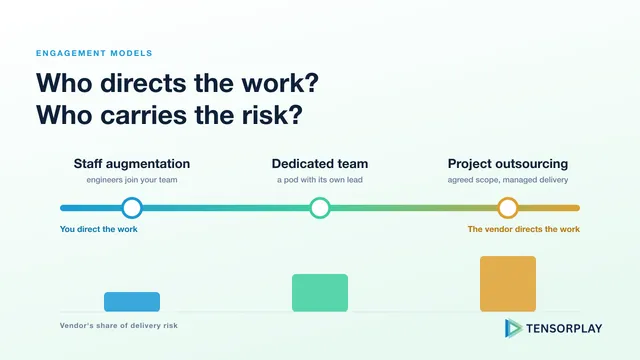
Staff augmentation, project outsourcing and dedicated teams compared for AI and software work: who directs the work, who carries delivery risk, how pricing works and when each fits.
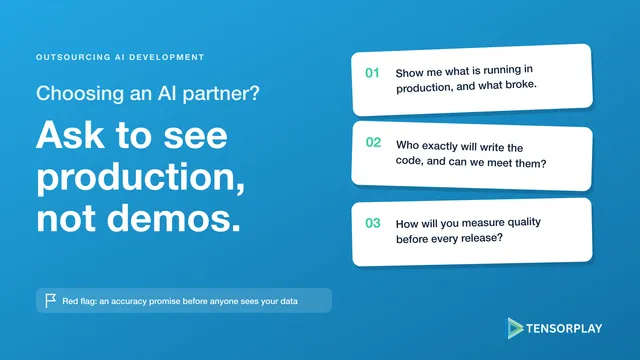
A practical guide to outsourcing AI development: the questions to ask a partner, the red flags to watch for, what to put in the contract, and how to run a paid trial.
For founders
Turn a raw idea into a working proof of concept or MVP in weeks, not months, so you can validate before you over-invest.
Book a discovery callFor AI builders
AI-native applications, curated datasets and trained models, built by engineers who run AI systems in production.
Discuss your AI projectFor scaling teams
Vetted tech specialists who plug directly into your sprint cycle, without the hiring overhead.
Request engineersFor tech leaders
Direct access to experienced engineering leaders for architecture reviews, engineering management and crisis unblocking.
Book a strategy session