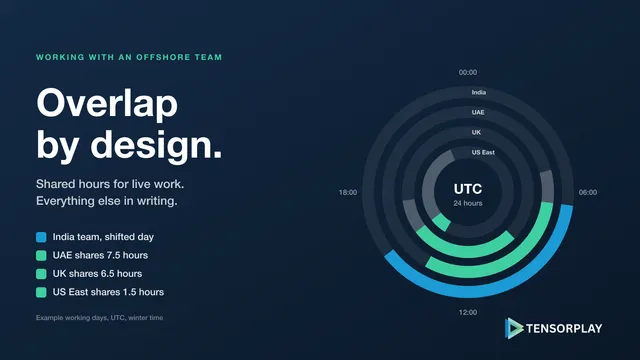
Working with an Offshore AI Team: Time Zones, IP and a Rhythm That Works
How to make an offshore AI or software team in India work from the US, UK, Europe or UAE: overlap hours, onboarding, security and IP, communication rhythm and what to measure.
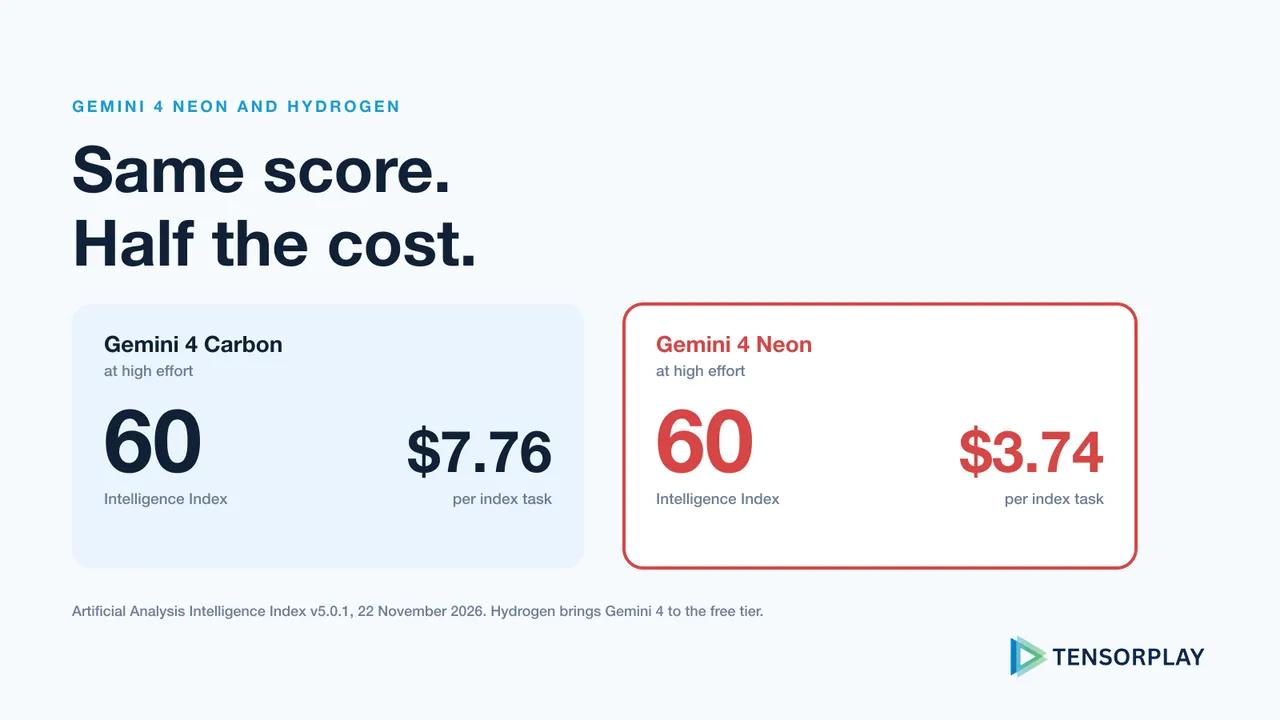
Google shipped two Gemini 4 models in six days. Neon matches Carbon on the Artificial Analysis Intelligence Index at default effort for less than half the cost per task. Hydrogen brings Gemini 4 to the free tier at Gemini 3.8 Flash's standard price. The effort setting matters more than which model you pick.
Google released Gemini 4 Hydrogen on 12 November and Gemini 4 Neon on 18 November. With Argon and Carbon, Gemini 4 is now a four-model family, and Google describes the roles clearly: “While Carbon tackles your hardest, long-horizon projects and Hydrogen handles fast everyday execution, Neon balances depth and efficiency.”
Carbon itself has moved on since our launch post. Google made it generally available on 10 November, so all four models can now be called through the Gemini API.
For most teams, these two releases matter more than Carbon did. Both are cheaper and faster, and Hydrogen brings Gemini 4 to the free tier. What the independent numbers show is less obvious: the effort setting changes cost and quality more than the choice between Neon and Hydrogen does.
Short on time? Watch the one-minute summary.
The Artificial Analysis Intelligence Index v5.0.1 runs the same nine evaluations on every model, including AA-Briefcase, Terminal-Bench 4.0 and FrontierCode-AA 2.0. Artificial Analysis is the primary source for its own index. Google’s prices and benchmarks below come from Google.
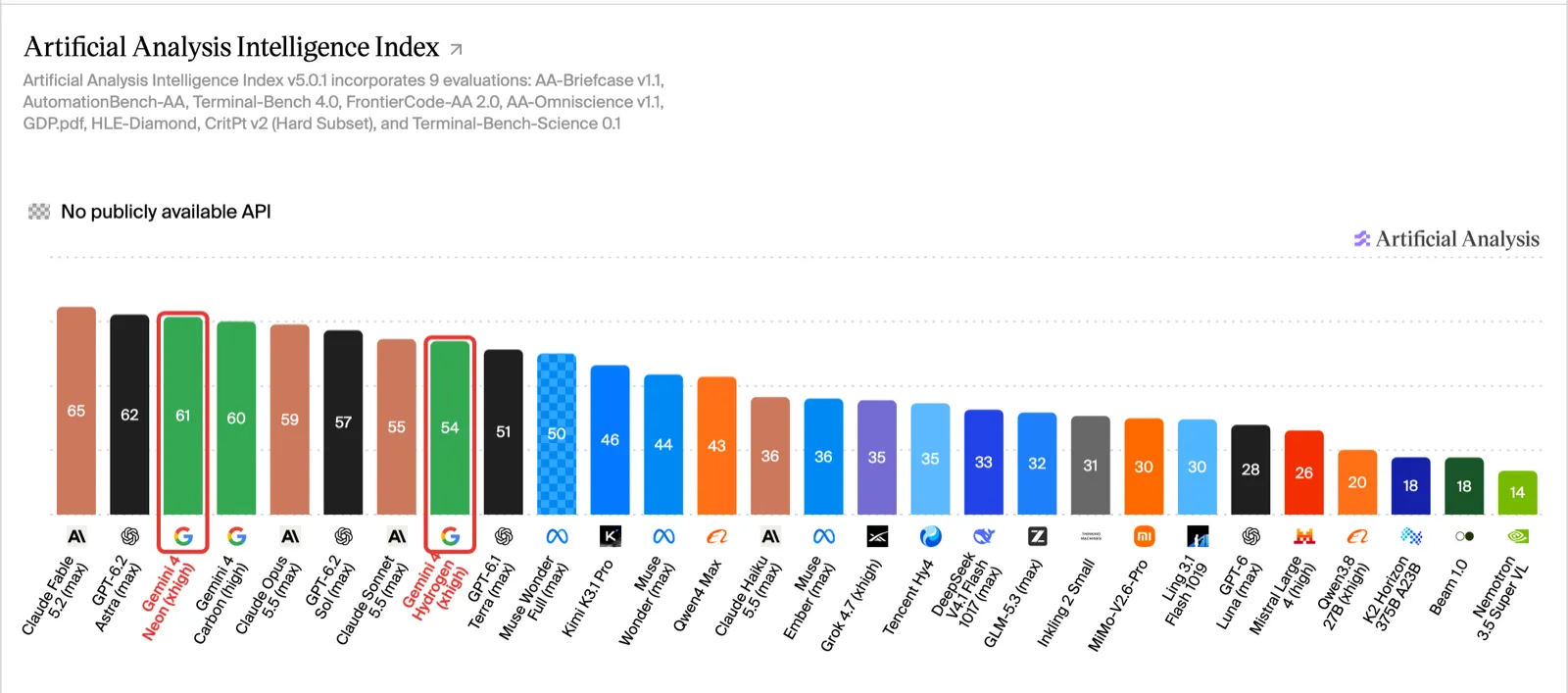
Source: Artificial Analysis Intelligence Index v5.0.1, default 28-model comparison. Screenshot taken 22 November 2026.
Neon at its highest xhigh setting scores 61. That puts it third, behind Claude Fable 5.2 at max effort (65) and GPT-6.2 Astra at max (62), and one point ahead of Carbon (60). It is now Google’s highest-scoring model. Hydrogen at xhigh scores 54, eighth in this view, behind Claude Sonnet 5.5 (55) and ahead of GPT-6.1 Terra (51).
If you open the model pages, Artificial Analysis ranks Neon “#6” and Hydrogen “#26”. Those pages count every effort setting of every model as a separate entry, so they are not the leaderboard rank.
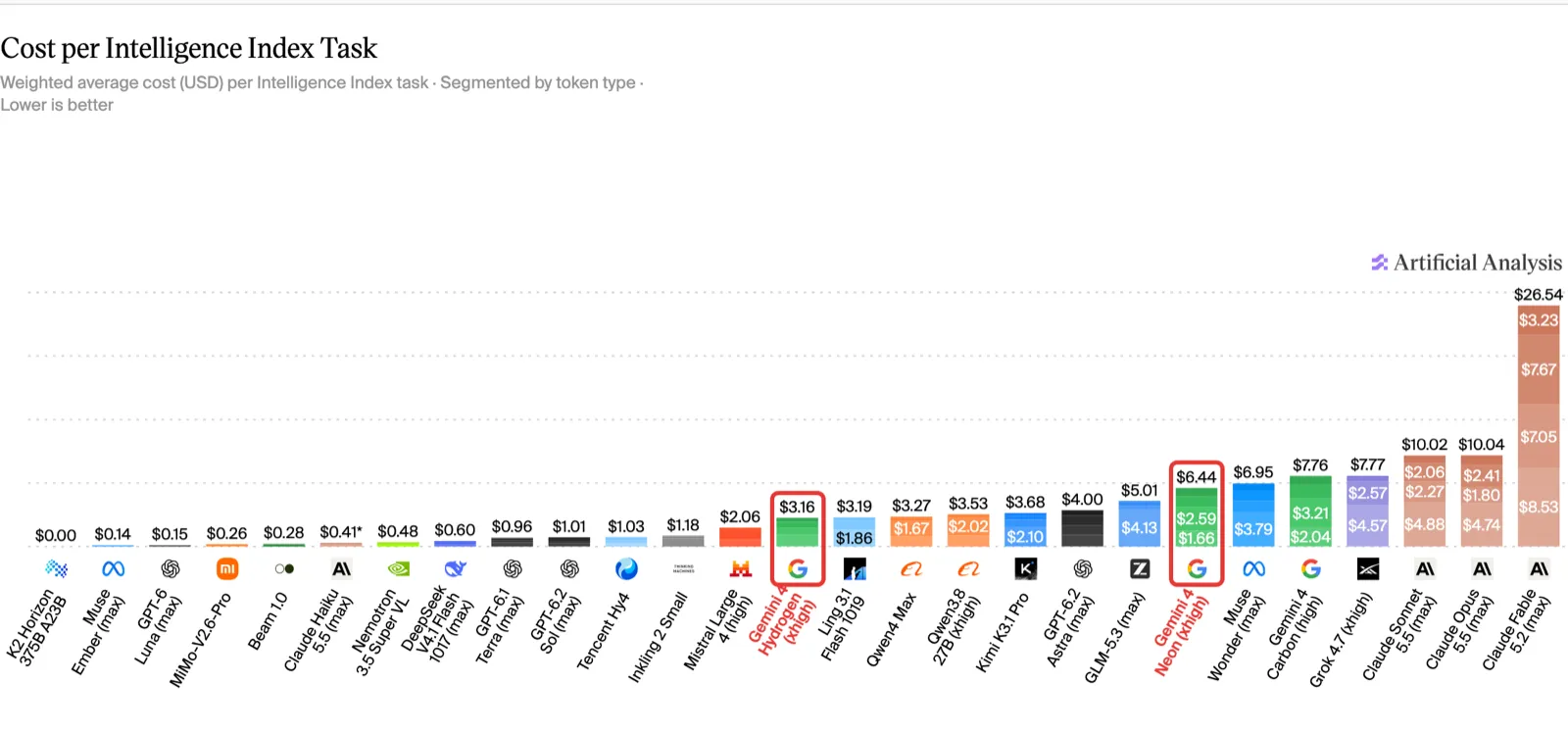
Source: Artificial Analysis, Cost per Intelligence Index Task, weighted average cost in USD per task, segmented by token type. Screenshot taken 22 November 2026.
| Model | Intelligence Index | Cost per task | Points per dollar |
|---|---|---|---|
| Claude Fable 5.2 (max) | 65 | $26.54 | 2.4 |
| GPT-6.2 Astra (max) | 62 | $4.00 | 15.5 |
| Gemini 4 Neon (xhigh) | 61 | $6.44 | 9.5 |
| Gemini 4 Carbon (high) | 60 | $7.76 | 7.7 |
| Claude Opus 5.5 (max) | 59 | $10.04 | 5.9 |
| GPT-6.2 Sol (max) | 57 | $1.01 | 56.4 |
| Claude Sonnet 5.5 (max) | 55 | $10.02 | 5.5 |
| Gemini 4 Hydrogen (xhigh) | 54 | $3.16 | 17.1 |
| GPT-6.1 Terra (max) | 51 | $0.96 | 53.1 |
Data from Artificial Analysis as of 22 November 2026. Points per dollar is our calculation, not an Artificial Analysis metric.
Three readings from this table:
Both models have four thinking levels: low, medium, high (the default) and a new xhigh. Carbon and Argon stop at high. At xhigh, both new models are very verbose: Artificial Analysis counted 283M output tokens across the index for Neon and 304M for Hydrogen, against 205M for Carbon and a median of 65.4M.
So the leaderboard numbers above, all at maximum effort, are not the ones most teams will run. Here is each model at each setting:
| Model and effort | Intelligence Index | Cost per task | Minutes per task |
|---|---|---|---|
| Neon (xhigh) | 61 | $6.44 | 22.3 |
| Neon (high) | 60 | $3.74 | 14.7 |
| Neon (medium) | 55 | $1.90 | 8.6 |
| Neon (low) | 44 | $0.75 | 3.7 |
| Hydrogen (xhigh) | 54 | $3.16 | 16.9 |
| Hydrogen (high) | 51 | $1.87 | 9.1 |
| Hydrogen (medium) | 41 | $0.80 | 3.9 |
| Hydrogen (low) | 27 | $0.29 | 1.5 |
| Carbon (high, default) | 60 | $7.76 | 34.7 |
Source: Artificial Analysis model and comparison pages, Intelligence Index v5.0.1, retrieved 22 November 2026.
Two rows stand out:
Hydrogen still has a clear job. At low and medium it is the cheapest and fastest Gemini 4 option. It also streams faster: Artificial Analysis measures about 153 output tokens per second at xhigh against 106 for Neon. And it is the only one with a free tier. For classification, extraction, short chat turns and high-volume subagents, its price per token matters more than its index score.
Google compares each model with two rivals of its own choosing. Neither table includes the two models that rank above Neon on the independent index.
| Benchmark | Neon | Opus 5.5 | GPT-6.2 Sol |
|---|---|---|---|
| AA Intelligence Index v5.0.1 | 61 | 59 | 57 |
| Vals Index v2.2 | 70.9% | 70.1% | 66.1% |
| CursorBench 4.1 | 65.4% | 58.1% | n/a |
| Terminal-Bench 4.1 (cheat-adjusted) | 65.2% | 65.8% | 61.5% |
| FrontierCode 2.0 | 46.2% | 47.3% | 43.8% |
| SWE-sweep (provider harness) | 39.0% | 10.1% | 8.3% |
| SWE-sweep (mini-SWE harness) | 12.8% | 3.6% | 11.6% |
| AutomationBench | 56.3% | 42.5% | 41.3% |
| Agents’ Last Exam v1.1 | 75.8% | 71.6% | 73.0% |
| RiemannBench | 84.0% | 80.0% | 80.0% |
| Terminal-Bench-Science 0.1 | 70.5% | 63.3% | 68.0% |
| HLE-Diamond | 71.3% | 67.9% | 64.0% |
| MKA (Climb WSR) | 56.5% | 53.0% | 52.7% |
| Chartography | 73.5% | 66.3% | 75.1% |
| LVBench | 89.0% | 83.7% | 87.6% |
| GraphWalks (256k to 1M, BFS F1) | 95.2% | 66.8% | 80.1% |
| CWE-Bench v2 | 70.7% | 67.1% | 66.0% |
| SEC-bench Pro | 90.5% | n/a | 88.3% |
| WebExploitBench v1.2 | 51.3% | 37.1% | n/a |
Source: Google, Gemini 4 Neon announcement, with methodology at deepmind.google/models/evals-methodology/gemini-4-neon. n/a means Google did not report a score.
Neon leads 16 of 19 rows. It trails Opus 5.5 narrowly on the two coding rows most teams care about, Terminal-Bench 4.1 and FrontierCode 2.0. The 39.0% SWE-sweep score uses Google’s own Antigravity harness, so compare it only with the 12.8% mini-SWE row, where the harness is the same for every model.
| Benchmark | Hydrogen | Sonnet 5.5 | GPT-6.1 Terra |
|---|---|---|---|
| SWE-sweep | 13.5% | 3.1% | 5.8% |
| Terminal-Bench 4.1 (cheat-adjusted) | 57.0% | 63.9% | n/a |
| Agents’ Last Exam v1.1 | 71.6% | 60.4% | 69.8% |
| AutomationBench-AA | 76.1% | 71.8% | 60.2% |
| Vending-Bench 2 (bank balance) | $14,549 | $11,165 | $9,107 |
| OSWorld-2.1 (offline subset) | 77.6% | 83.9% | 74.2% |
| MKA (Climb WSR) | 53.4% | 52.0% | 43.8% |
| Chartography | 66.6% | 61.6% | 63.2% |
| Terminal-Bench-Science 0.1 | 51.4% | 59.9% | 58.3% |
| HLE-Diamond | 58.8% | 53.3% | 47.3% |
Source: Google, Gemini 4 Hydrogen announcement, with methodology at deepmind.google/models/evals-methodology/gemini-4-hydrogen. n/a means Google did not report a score.
Hydrogen leads 7 of 10. It trails Sonnet 5.5 on terminal coding, computer use and science. If your product drives a desktop or a shell, test those rows yourself. Against its predecessor, Google reports 57% on Terminal-Bench 4.1 against 18.2% for Gemini 3.8 Flash, and tasks finished 2.5 times faster at the default setting.
| Model | Input / 1M | Cached input | Output / 1M | Free tier |
|---|---|---|---|---|
| Gemini 4 Hydrogen | $1.50 | $0.075 | $7.50 | Yes |
| Gemini 4 Neon | $3.00 | $0.15 | $15.00 | No |
| Gemini 4 Carbon | $2.00, then $4.00 | $0.10, then $0.20 | $10.00, then $20.00 | No |
| Gemini 3.8 Flash | $0.75, then $1.50 | $0.075, then $0.15 | $3.75, then $7.50 | Yes |
Source: Gemini API pricing, standard paid tier, retrieved 22 November 2026. Carbon and Argon rise on 1 December 2026. Gemini 3.8 Flash rises on 1 January 2027. Batch and Flex are half price for all four.
Three dates and prices to plan around:
Access differs more than price:
gemini-4-hydrogen, in the Gemini app for everyone (free users get it through automatic model selection), in Search, in Google Antigravity and in Gemini for business. Google Cloud lists it with a 12 November release date and no retirement date.gemini-4-neon. In AI Studio chat, the Gemini app and Google Antigravity it is limited to Google AI Pro and Ultra subscribers, and it is now the default for new Antigravity conversations on those plans. It is in Gemini for business. As of 22 November it is not yet on the Google Cloud model versions page, so confirm availability with your account team if you buy through Google Cloud.From the Gemini API docs for Neon and the Google Cloud docs for Hydrogen:
minimal thinking is rejected. Both models return an error for it. Hydrogen also returns an HTTP 400 error for thinking_budget. If your code still sends a thinking budget from the Gemini 3.x era, switch to thinking_level.high. Carbon and Argon default to medium. If you swap model IDs without setting the level, expect longer and costlier responses.Early users of xhigh in Antigravity reported errors in the first days after Neon’s launch. A Google staff reply on the developer forum on 20 November said normal behaviour had returned on 19 November. Keep a fallback model configured for the first weeks of any launch.
Google reports these from its own evaluations. Treat them as direction, not proof:
As in our Carbon post, a low prompt-injection score does not make an agent safe if it can still take irreversible actions on untrusted input. Keep approvals and least-privilege tools in place.
low or medium and raise the level only where your evaluation shows a gain.thinking_budget or minimal settings first.Neon is the most useful Gemini release for production teams this autumn: Carbon-level results at default effort, faster, and priced below Carbon from December. Hydrogen makes Gemini 4 available on the free tier and is the natural upgrade from Flash. The gains come from choosing the effort level per task. If you want help setting up the evaluation and routing that make those choices measurable, talk to Tensorplay about a model readiness review.
Answers to common questions about this topic.
How to make an offshore AI or software team in India work from the US, UK, Europe or UAE: overlap hours, onboarding, security and IP, communication rhythm and what to measure.
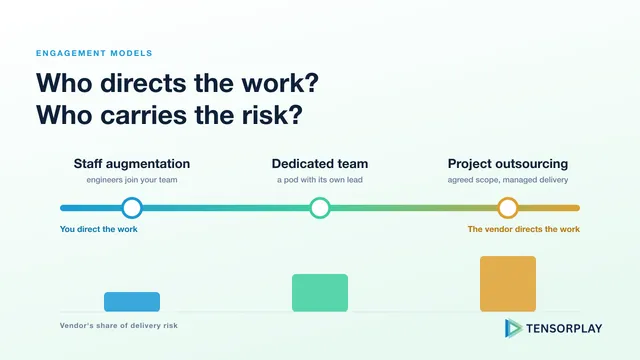
Staff augmentation, project outsourcing and dedicated teams compared for AI and software work: who directs the work, who carries delivery risk, how pricing works and when each fits.
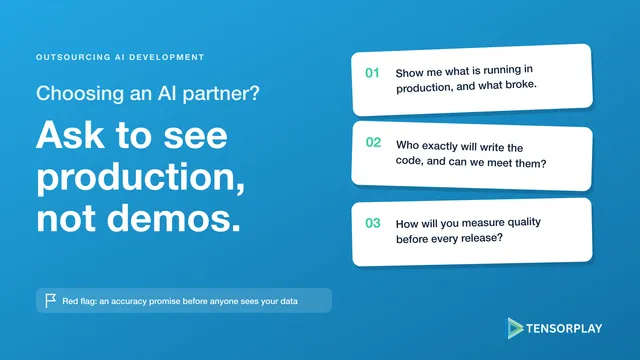
A practical guide to outsourcing AI development: the questions to ask a partner, the red flags to watch for, what to put in the contract, and how to run a paid trial.
For founders
Turn a raw idea into a working proof of concept or MVP in weeks, not months, so you can validate before you over-invest.
Book a discovery callFor AI builders
AI-native applications, curated datasets and trained models, built by engineers who run AI systems in production.
Discuss your AI projectFor scaling teams
Vetted tech specialists who plug directly into your sprint cycle, without the hiring overhead.
Request engineersFor tech leaders
Direct access to experienced engineering leaders for architecture reviews, engineering management and crisis unblocking.
Book a strategy session