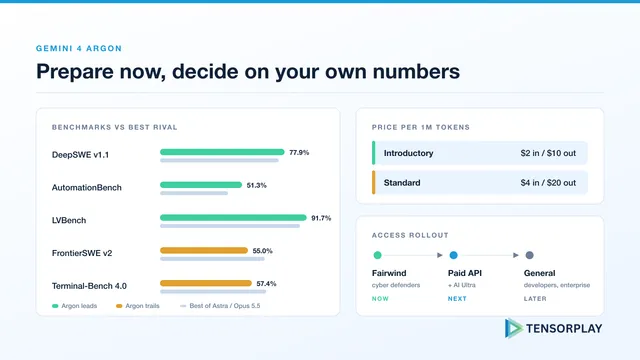
Gemini 4 Argon: Get Ready Before You Can Call It
Gemini 4 Argon for production AI teams: benchmarks against GPT-6 Astra and Opus 5.5, pricing that doubles after launch, 1M output tokens and a readiness plan.
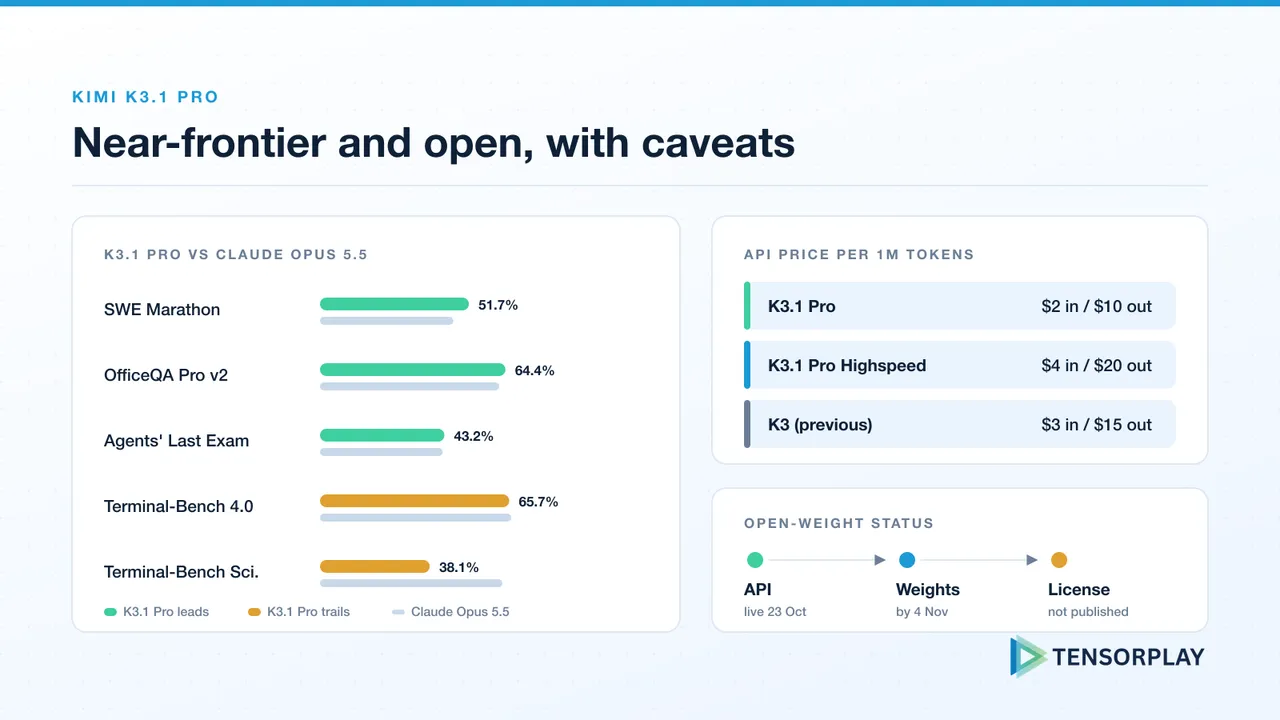
Moonshot's new model comes within a point of Claude Opus 5.5 on agentic coding at half the price, with open weights due by 4 November. The licence is still the open question.
Moonshot AI released Kimi K3.1 Pro on 23 October 2026, together with a faster K3.1 Pro Highspeed variant (Kimi). It is a post-trained version of Kimi K3 with substantially more post-training compute. Moonshot calls it its most capable 3T-class open-weight model, with a 1 million token context window and text, image and video input.
Two things make it worth a production team’s attention. First, on agentic coding it is within a point of Claude Opus 5.5 at half the list price. Second, Moonshot says the full weights will be published by 4 November. If they are, K3.1 Pro becomes the highest-scoring open-weight model on the Artificial Analysis Intelligence Index, three points behind the best proprietary model rather than twelve.
The second point has a large caveat. Moonshot has not published the licence, and until it does, nobody can say whether the weights are usable in a commercial product.
Every row except the Intelligence Index comes from Moonshot’s published benchmark chart, which ran all models at maximum thinking effort (Kimi). The Intelligence Index is independent.
| Benchmark | Kimi K3.1 Pro | Claude Opus 5.5 | GPT-6 Astra |
|---|---|---|---|
| Terminal-Bench 4.0 | 65.7% | 66.4% | 58.2% |
| SWE Marathon | 51.7% | 46.3% | 42.5% |
| Agents’ Last Exam | 43.2% | 42.6% | 41.8% |
| OfficeQA Pro v2 | 64.4% | 62.2% | 54.4% |
| HLE Full (with tools) | 70.0% | 67.7% | 57.2% |
| GDPval-AA v2.1 (Elo) | 1,846 | 1,866 | 1,573 |
| OSWorld V2.1 | 79.6% | 81.8% | 75.8% |
| BenchCAD (with tools) | 92.7% | 96.2% | 95.9% |
| Terminal-Bench-Science 0.1 | 38.1% | 63.3% | 68.1% |
| AA Intelligence Index (independent) | 55 | 58 | 53 |
Against K3, Moonshot’s comparisons are on internal benchmarks: Kimi Code Bench 3.0 Long-horizon rises from 55.95% to 61.2%, internal financial research from 58.8 to 70.4, and internal business operations from 8.9 to 37. On the independent Intelligence Index, the score rose from 44 for K3 to 55 (Artificial Analysis).
The pattern is a model that is strong at long-running agent work and office-document tasks, close behind on computer use, and well behind on scientific terminal work and offensive security. The security gap is deliberate, which we come back to below.
Moonshot also reports claim-level hallucinations on its internal Kimi Hallu Bench Hard falling from 23.4% for K3 to 8.3%, against 15.0% for Opus 5.5 and 5.5% for GPT-6 Astra. Moonshot itself calls this “a stress test, not a measure of general error rates”, so treat it as directional. If factual accuracy matters to your product, the evaluation set you already own is a better guide than any vendor benchmark.
Vendor tables pick their own comparisons. The Artificial Analysis leaderboard runs the same ten evaluations on every model, including agentic, knowledge-work, coding, science and long-context tasks, so it is the fairest single view of where K3.1 Pro sits.
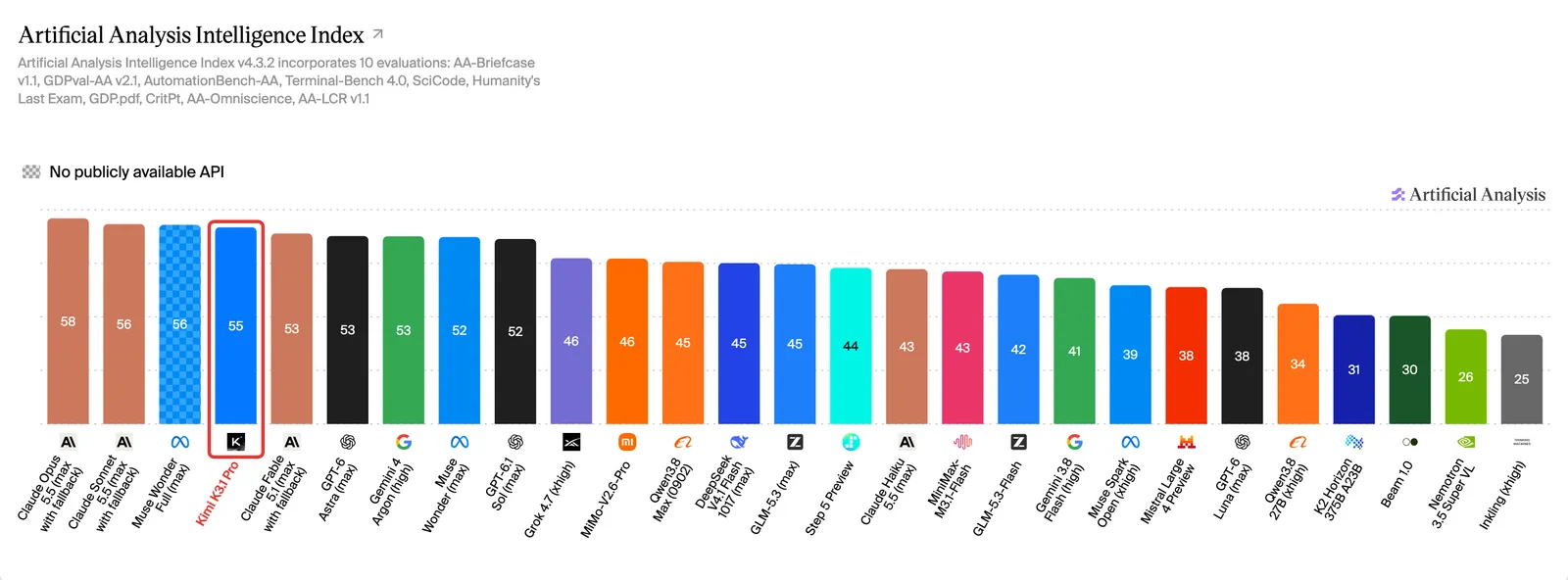
Source: Artificial Analysis Intelligence Index v4.3.2, default 27-model comparison. Screenshot taken 25 October 2026. Scores are updated as models are re-run, so current values may differ.
K3.1 Pro scores 55, fourth behind Claude Opus 5.5 (58), Claude Sonnet 5.5 (56) and Muse Wonder Full (56). Muse Wonder Full has no public API, so among models you can actually call, K3.1 Pro is third. It is ahead of Claude Fable 5.1, GPT-6 Astra and Gemini 4 Argon, all at 53, and of GPT-6.1 Sol at 52.
The open-weight comparison is the bigger story. Before this release, the strongest open-weight model was Xiaomi’s MiMo-V2.6-Pro at 46. If the K3.1 Pro weights ship as promised, the best open-weight model moves from 12 points behind the leader to 3.
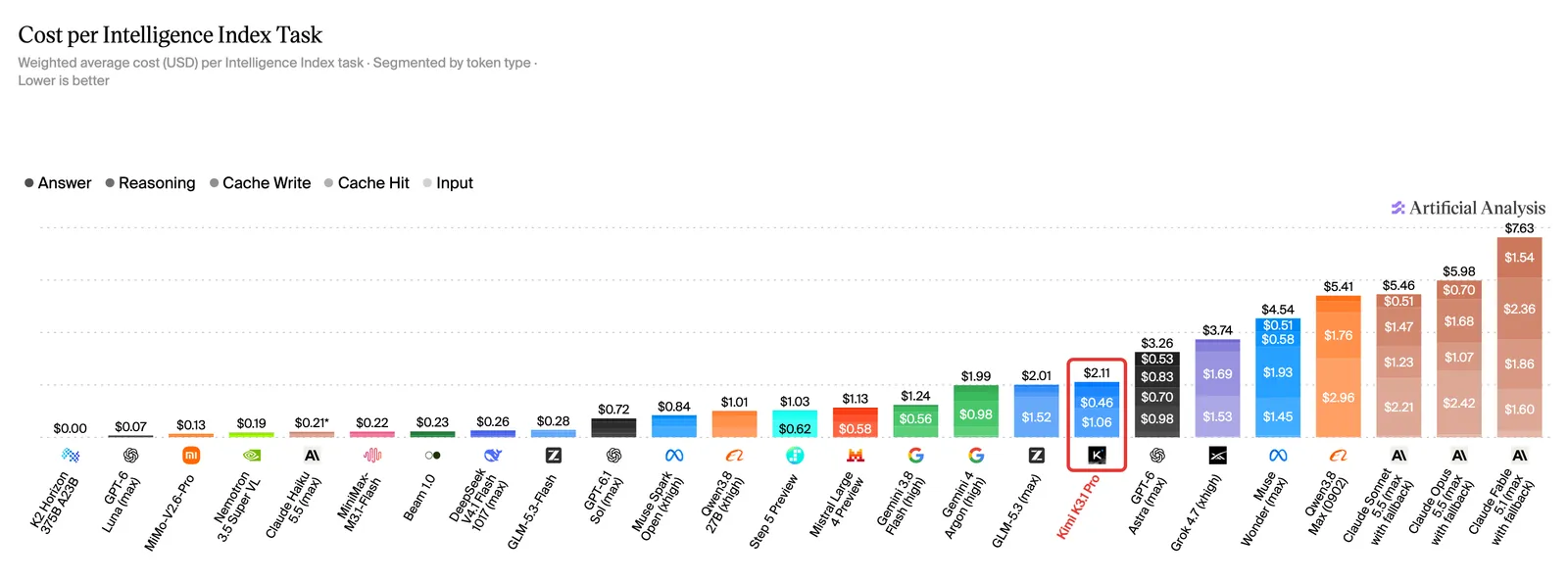
Source: Artificial Analysis, Cost per Intelligence Index Task, weighted average cost in USD per task, segmented by token type. Screenshot taken 25 October 2026.
Cost per task is more useful than price per token because it includes how many tokens a model spends reasoning. K3.1 Pro costs $2.11 per Intelligence Index task. Against the models it competes with:
| Model | Intelligence Index | Cost per task | Points per dollar |
|---|---|---|---|
| Claude Opus 5.5 | 58 | $5.98 | 9.7 |
| Claude Sonnet 5.5 | 56 | $5.46 | 10.3 |
| Kimi K3.1 Pro | 55 | $2.11 | 26.1 |
| GPT-6 Astra | 53 | $3.26 | 16.3 |
| Gemini 4 Argon | 53 | $1.99 | 26.6 |
| GPT-6.1 Sol | 52 | $0.72 | 72.2 |
| MiMo-V2.6-Pro | 46 | $0.13 | 353.8 |
Data from Artificial Analysis as of 25 October 2026. Points per dollar is our calculation, not an Artificial Analysis metric.
Three readings matter for model selection:
| Model | Input / 1M | Cached input / 1M | Output / 1M |
|---|---|---|---|
| Kimi K3.1 Pro | $2.00 | $0.20 | $10.00 |
| K3.1 Pro Highspeed | $4.00 | $0.20 | $20.00 |
| Kimi K3 (previous) | $3.00 | $0.30 | $15.00 |
| Claude Opus 5.5 | $4.00 | n/a | $20.00 |
K3.1 Pro prices are from Moonshot’s pricing page. Cache writes are billed separately, at $2.00 per million tokens for a 5-minute TTL and $4.00 for 1 hour on K3.1 Pro. The Opus 5.5 figure is Anthropic’s list price from our September roundup.
Per token, K3.1 Pro is about a third cheaper than K3 and matches GPT-6 Sol. Per task, it is not cheaper at all: Artificial Analysis measures $2.11 per Intelligence Index task for K3.1 Pro against $2.00 for K3. Measure cost per successful outcome on your own workflows, not cost per token. The LLM inference cost guide covers how.
Highspeed is the same model at double the price for two to three times the output speed. It only speeds up generation, not tool calls, so for agent loops dominated by tool latency it buys less than the headline suggests. It suits interactive coding and user-facing chat, where time to the last token is what people notice.
The API is reachable with the model IDs kimi-k3.1-pro and kimi-k3.1-pro-highspeed, and Zero Data Retention is available for API customers. Several behaviours in Moonshot’s Kimi Code model documentation differ from what most client code assumes:
reasoning_effort accepts low, high and max. Moonshot’s published benchmarks use max, so expect lower scores and fewer output tokens at the default.Moonshot removed cyber-related data from both mid-training and reinforcement learning for the open-weight release, while keeping general-purpose coding data. On its internal xdev-bench-hard exploit benchmark, the checkpoint without these measures solved 90.5% of tasks, and the released model solves 81.0% (The Next Web). Moonshot says its cyber capability remains behind frontier proprietary models that have been public for at least three months.
The reasoning is that open weights cannot be recalled once downloaded. For defenders, this has two consequences. K3.1 Pro is a weaker choice for vulnerability research than the proprietary models, and 81% on an exploit benchmark is still a lot of capability in a model anyone will be able to run. Keep the threat model for your AI applications current, and keep patch windows short for internet-facing services.
For teams with data-residency or sovereignty constraints, a self-hosted model at this level would change what can run on-premises. Before planning around that, be clear about what is not known yet:
high and max effort.K3.1 Pro may let you run near-frontier quality on infrastructure you control. Whether it does depends on your evaluation results and a licence that has not been written yet. If you want help building the evaluation and routing layer that answers that quickly, talk to Tensorplay about a model readiness review.
Answers to common questions about this topic.
Gemini 4 Argon for production AI teams: benchmarks against GPT-6 Astra and Opus 5.5, pricing that doubles after launch, 1M output tokens and a readiness plan.

Tensorplay launches Rêver Studio, an online client gallery for photographers in India with 40+ themes, AI face grouping and AI culling that flags duplicates, blur and closed eyes. Start free with 5 GB.
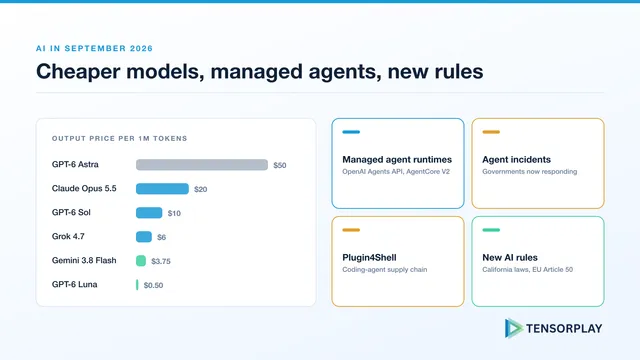
The AI news from September 2026 that matters to teams shipping AI: Claude Opus 5.5, GPT-6 Sol and Luna pricing, OpenAI's Agents API, Plugin4Shell, California's new AI laws and a migration checklist.
Turn prototypes into reliable, observable, and scalable AI systems.
Discuss your projectImprove model quality, control costs, and establish repeatable evaluation systems.
Discuss your project