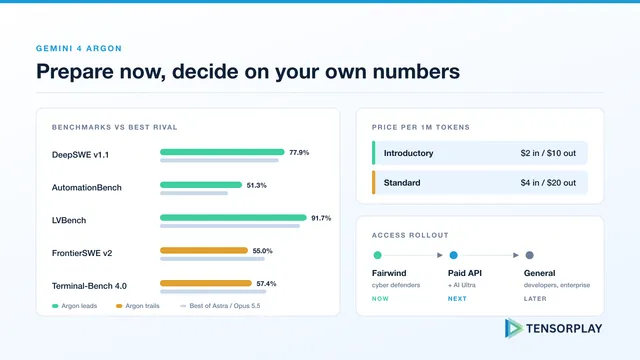
Gemini 4 Argon: Get Ready Before You Can Call It
Gemini 4 Argon for production AI teams: benchmarks against GPT-6 Astra and Opus 5.5, pricing that doubles after launch, 1M output tokens and a readiness plan.
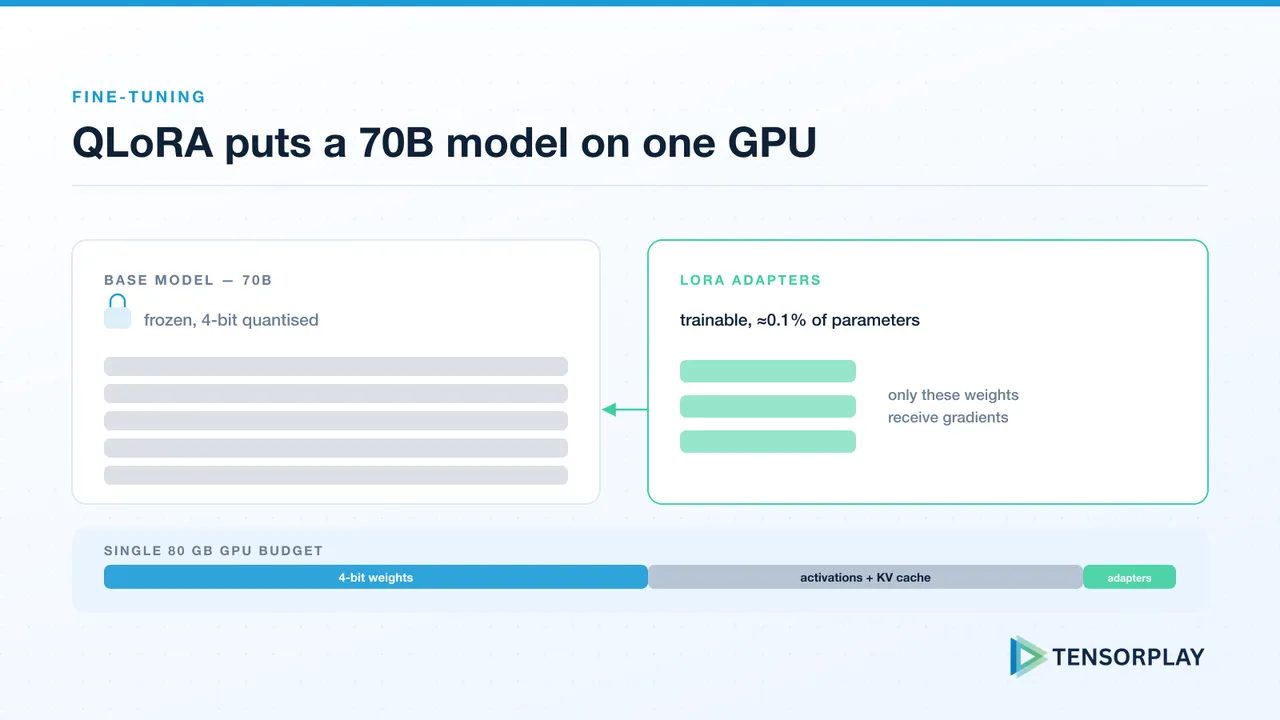
QLoRA (Quantized Low-Rank Adaptation) changed the economics of LLM fine-tuning. Before QLoRA, fine-tuning a 70B model required a cluster of A100s and a substantial cloud budget. With QLoRA, it fits on a single 80GB GPU — or even a 40GB GPU with some compromises.
Before you start, check that fine-tuning is the right tool: if the problem is missing or fast-changing knowledge rather than behaviour, RAG is usually the better choice. Here’s a practical walkthrough of the process we use at Tensorplay for client fine-tuning projects.
QLoRA combines two techniques:
The result: you train only ~0.1-1% of the parameters, while the frozen quantized base model provides the language understanding. Memory during training is dominated by the adapters and optimizer states, not the full model.
Fine-tuning quality is overwhelmingly determined by data quality, not hyperparameter tuning. For every fine-tuning project, we invest heavily in:
For most task-specific fine-tuning, 1,000-10,000 high-quality examples is sufficient. More data rarely helps if quality is maintained.
import torch
from transformers import BitsAndBytesConfig
from peft import LoraConfig

# Quantization config
bnb_config = BitsAndBytesConfig(
    load_in_4bit=True,
    bnb_4bit_quant_type="nf4",
    bnb_4bit_compute_dtype=torch.bfloat16,
    bnb_4bit_use_double_quant=True,
)

# LoRA config
lora_config = LoraConfig(
    r=16,                  # rank - higher = more capacity, more memory
    lora_alpha=32,         # scaling factor
    target_modules=["q_proj", "v_proj", "k_proj", "o_proj"],
    lora_dropout=0.05,
    bias="none",
    task_type="CAUSAL_LM",
)
Start with r=16 and increase if your validation loss plateaus. Target all attention projection matrices, not just q and v, for better results on complex tasks.
Before training, run your evaluation suite on the base model to establish a baseline. If you don’t have one yet, our LLM evaluation framework covers how to build it. After training, compare carefully: fine-tuned models often improve dramatically on the target task while degrading on general tasks — this is expected and acceptable if you only need the target task.
Watch for catastrophic forgetting: if your model needs to maintain broad capabilities alongside the new skill, use a training dataset that includes examples representative of those general capabilities.
Fine-tuning is powerful but requires careful data work and rigorous evaluation. Serving the result efficiently is its own project; our guide to GPU inference on a budget covers serving frameworks and quantisation for deployment. If your team has a specific task that a fine-tuned model would solve better than prompt engineering, talk to Tensorplay about the options.
Answers to common questions about this topic.
Gemini 4 Argon for production AI teams: benchmarks against GPT-6 Astra and Opus 5.5, pricing that doubles after launch, 1M output tokens and a readiness plan.
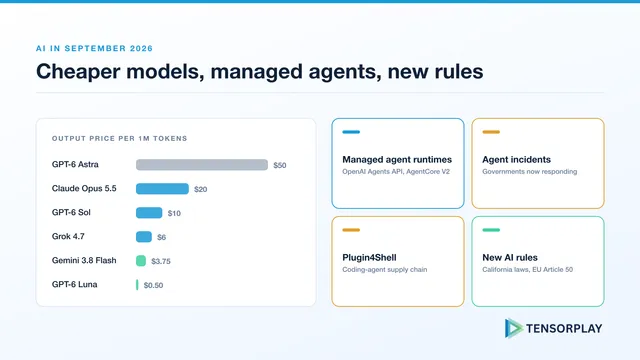
The AI news from September 2026 that matters to teams shipping AI: Claude Opus 5.5, GPT-6 Sol and Luna pricing, OpenAI's Agents API, Plugin4Shell, California's new AI laws and a migration checklist.
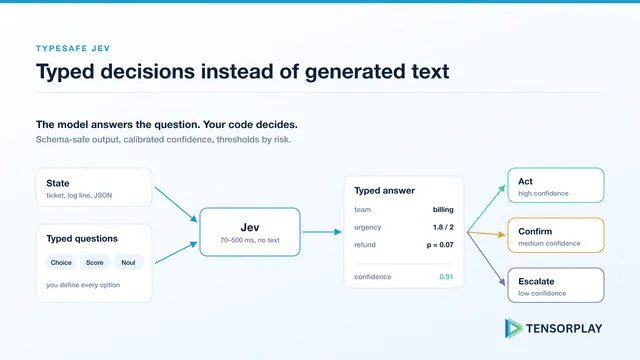
TypeSafe's Jev explained for production AI teams: typed Choice, Score and Noul answers, confidence gating, $0.042 per million input tokens, and the caveats in its benchmarks.
Improve model quality, control costs, and establish repeatable evaluation systems.
Discuss your project