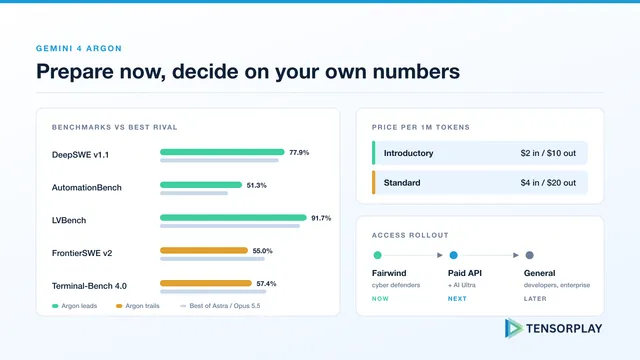
Gemini 4 Argon: Get Ready Before You Can Call It
Gemini 4 Argon for production AI teams: benchmarks against GPT-6 Astra and Opus 5.5, pricing that doubles after launch, 1M output tokens and a readiness plan.
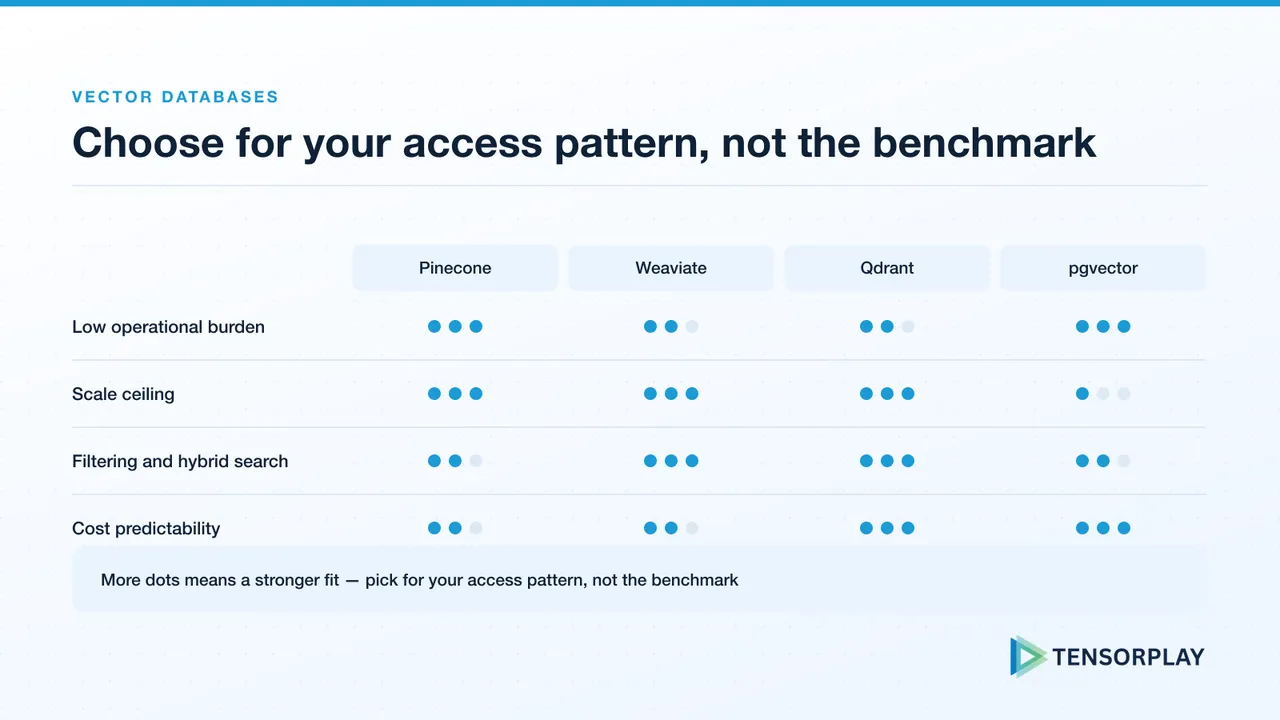
Pinecone, Weaviate, Qdrant, pgvector — each has different trade-offs. Here's how to choose.
Vector databases are now a core piece of production AI infrastructure. Whether you’re building a RAG pipeline, a semantic search engine, or a recommendation system, you need somewhere to store and efficiently retrieve high-dimensional embeddings. If you are still deciding whether retrieval is the right approach at all, start with RAG vs fine-tuning.
The market has exploded with options. Here’s how we evaluate them for client projects.
Before comparing databases, clarify your requirements:
Fully managed, serverless, zero infrastructure management. Excellent developer experience and reliable performance. The trade-off: higher cost at scale and limited customization. Best for teams that want to move fast and aren’t yet at a scale where infrastructure costs are a concern.
Open-source and self-hostable, but also offers a managed cloud. Strong built-in support for hybrid search (combining dense and sparse retrieval), a native GraphQL API, and module-based architecture for embedding generation. Good choice for teams needing more control over their stack.
Rust-based, extremely fast, excellent performance per dollar. Supports payload (metadata) filtering efficiently. Great for high-throughput use cases. Self-hosted with a managed cloud option. Increasingly our go-to for performance-critical projects.
A PostgreSQL extension that adds vector similarity search. If your data is already in Postgres, this is often the pragmatic choice — one less system to manage, ACID transactions, familiar tooling. Performance lags behind dedicated vector databases at very large scale, but is totally fine up to tens of millions of vectors.
Excellent for local development and prototyping. Not our recommendation for production at significant scale, but a fantastic tool for getting a RAG proof-of-concept running quickly.
| Use Case | Our Pick |
|---|---|
| Fast prototype / low volume | Chroma or pgvector |
| Already on Postgres, < 10M vectors | pgvector |
| Managed cloud, moving fast | Pinecone |
| Self-hosted, high performance | Qdrant |
| Hybrid search requirements | Weaviate |
| Billion-scale | Weaviate or Qdrant (custom deployment) |
Choosing the right vector store is one of the first architectural decisions in any RAG project, and getting it wrong is expensive to fix later. It is also only one part of retrieval quality: chunking, freshness and access control matter just as much, as covered in RAG reliability in production. If you’d like a recommendation tailored to your specific use case, talk to Tensorplay about your retrieval architecture.
Answers to common questions about this topic.
Gemini 4 Argon for production AI teams: benchmarks against GPT-6 Astra and Opus 5.5, pricing that doubles after launch, 1M output tokens and a readiness plan.
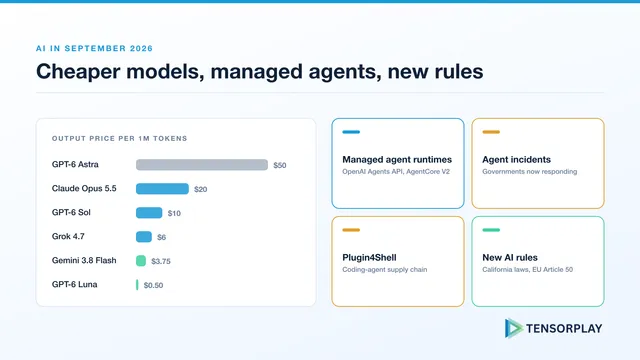
The AI news from September 2026 that matters to teams shipping AI: Claude Opus 5.5, GPT-6 Sol and Luna pricing, OpenAI's Agents API, Plugin4Shell, California's new AI laws and a migration checklist.
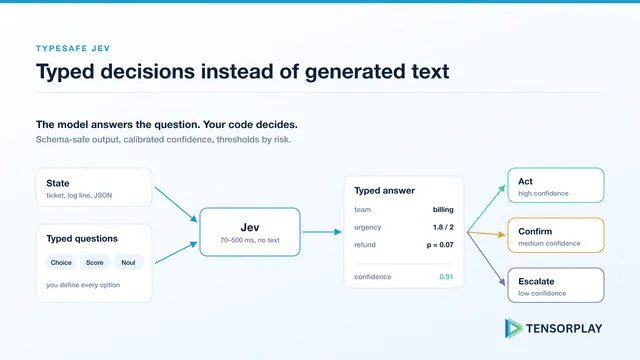
TypeSafe's Jev explained for production AI teams: typed Choice, Score and Noul answers, confidence gating, $0.042 per million input tokens, and the caveats in its benchmarks.
Improve model quality, control costs, and establish repeatable evaluation systems.
Discuss your projectBuild secure inference platforms with predictable performance and spend.
Discuss your project